

Greater Yellowlegs
Last week I wrote about a sandpiper called a Lesser Yellowlegs, which has a robin-sized body, but with very long yellow legs. You may have guessed that there is another sandpiper called a Greater Yellowlegs. Like Lesser Yellowlegs, Greaters pass through each fall and spring, visiting exposed muddy areas and flooded fields.
Greater Yellowlegs key facts
| Scientific name | Tringa melanoleuca |
|---|---|
| Family | Scolopacidae (Sandpipers and Allies) |
| Order | Charadriiformes |
| eBird species page | Greater Yellowlegs on eBird (code greyel) |
Fun fact: After locating a fish, the yellowlegs will quickly run forward to chase it down, often diving head first into the water to make the catch.
Even though Greater Yellowlegs stand about three inches taller and weigh about twice as much, it can be challenging to tell them apart from Lesser Yellowlegs by size alone. The size of a bird can be difficult to judge if it’s not standing near something you can use as a reference. When the two sandpipers stand close to each other, the size difference is obvious. The more reliable method to identify these two species is to look at the shape and relative size of the bill. Lesser Yellowlegs have a thinner, shorter bill. Greater Yellowlegs have a thicker, longer bill that bends slightly upward near the tip.
Both yellowlegs forage for insects, crustaceans, and other arthropods by wading into shallow water. Greater Yellowlegs are more likely to spend time catching fish. After locating a fish, the yellowlegs will quickly run forward to chase it down, often diving head first into the water to make the catch.
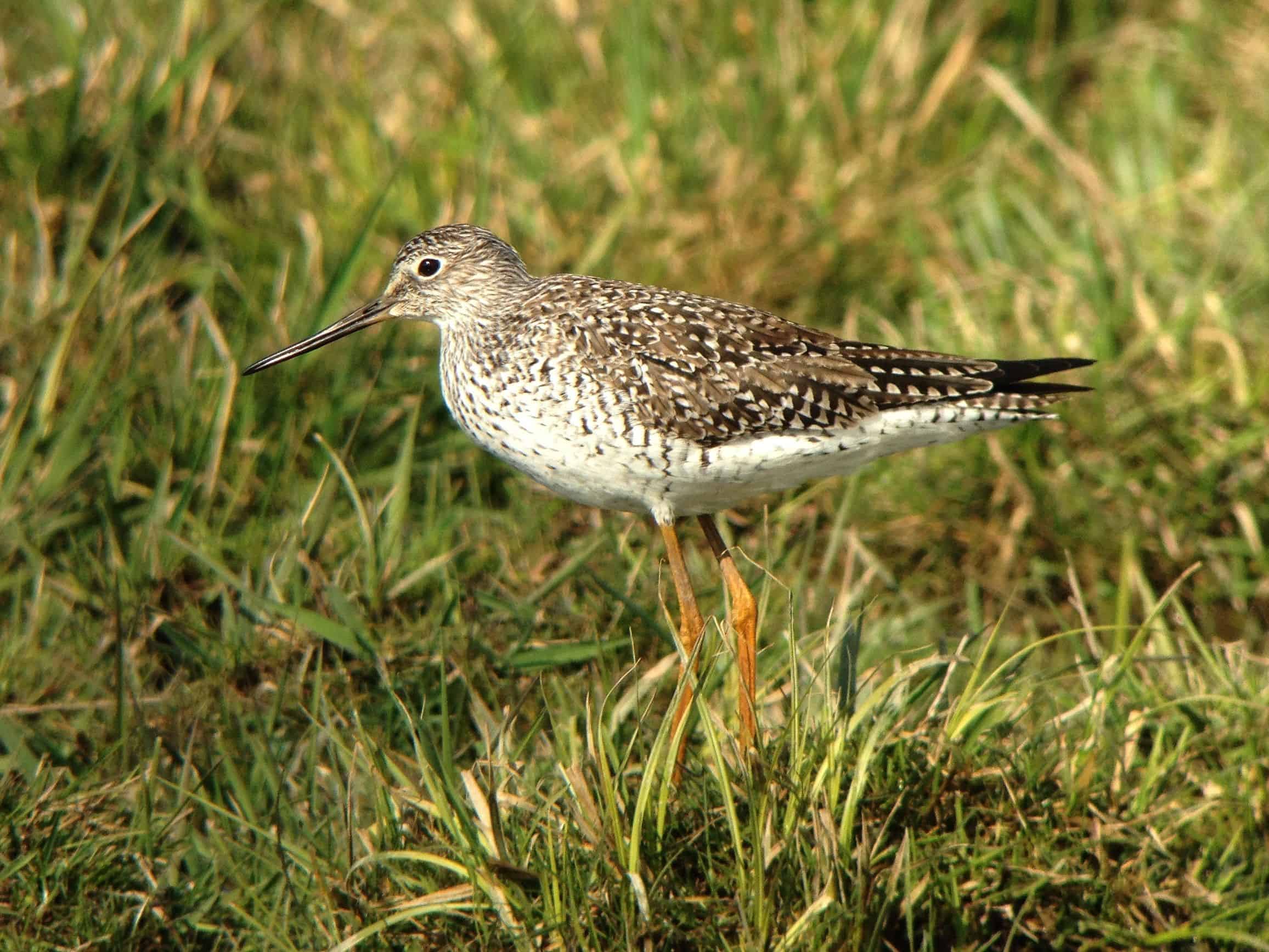
Greater Yellowlegs in Berks County (March 2016).

Greater Yellowlegs in Berks County (March 2016).
Greater Yellowlegs
Last week I wrote about a sandpiper called a Lesser Yellowlegs, which has a robin-sized body, but with very long yellow legs. You may have guessed that there is another sandpiper called a Greater Yellowlegs. Like Lesser Yellowlegs, Greaters pass through each fall and spring, visiting exposed muddy areas and flooded fields.
Greater Yellowlegs key facts
| Scientific name | Tringa melanoleuca |
|---|---|
| Family | Scolopacidae (Sandpipers and Allies) |
| Order | Charadriiformes |
| eBird species page | Greater Yellowlegs on eBird (code greyel) |
Fun fact: After locating a fish, the yellowlegs will quickly run forward to chase it down, often diving head first into the water to make the catch.
Even though Greater Yellowlegs stand about three inches taller and weigh about twice as much, it can be challenging to tell them apart from Lesser Yellowlegs by size alone. The size of a bird can be difficult to judge if it’s not standing near something you can use as a reference. When the two sandpipers stand close to each other, the size difference is obvious. The more reliable method to identify these two species is to look at the shape and relative size of the bill. Lesser Yellowlegs have a thinner, shorter bill. Greater Yellowlegs have a thicker, longer bill that bends slightly upward near the tip.
Both yellowlegs forage for insects, crustaceans, and other arthropods by wading into shallow water. Greater Yellowlegs are more likely to spend time catching fish. After locating a fish, the yellowlegs will quickly run forward to chase it down, often diving head first into the water to make the catch.


About The Author
Dan Hinnebusch is the Ornithologist for Wild Birds Unlimited. Learn more about Dan Hinnebusch.
