

Life Bird: Virginia’s Warbler
When a birder sees a species of bird that they’ve never seen before, they call it a life bird. I’ve been birding in Pennsylvania now for more than three decades, and it’s gotten very difficult for me to see lifebirds in the state. That’s why I was so excited this weekend to learn that another birder had found a Virginia’s Warbler in Montgomery County. That’s not just a new bird for me – it’s the first time that species has ever been reported in Pennsylvania. Within minutes of arriving, I joined dozens of other birders as we enjoyed great looks at the little bird as it actively foraged in the bushes and vines of a hillside right next to the parking area.
Virginia’s Warblers are typically found nesting in steep-sloped, dry forest habitat in the Rocky Mountains, especially in the Four Corners states of Utah, Colorado, New Mexico, and Arizona. It migrates to southwestern Mexico during the winter. This species wasn’t discovered until just before the Civil War, and it remains one of the least studied warbler species in the United States. Long-distance migrants sometimes fly in the wrong direction. It’s likely that the Virginia’s Warbler visiting Pennsylvania arrived last fall after taking the wrong course in fall migration. If that’s the case, it’s remarkable it was able to survive the cold, snowy winter we just had.
There are a few close relatives of Virginia’s Warbler that you can find in Pennsylvania each year. It’s closest relative is the Nashville Warbler (also pictured), which nests in the northern half of Pennsylvania. The two species have a similar pattern of coloration, with yellow on the throat and beneath the tail, plus a subtle patch of dark orange on the crown of the male. Compared to Virginia’s, Nashville is more colorful, with a yellow breast and belly, as well as greenish wings. Nashville and Virginia’s Warblers are also in the same genus as Orange-crowned Warbler and Tennessee Warbler, both of which pass through each year during spring and fall migration.
The name of the Virginia’s Warbler has nothing to do with the state of Virginia. The man who discovered the species in New Mexico in 1858 requested that the bird be named after his wife. Virginia’s Warbler is one of five warblers that were named after women. The Blackburnian Warbler was named in 1785 for Anna Blackburne, an English botanist. In the 1860s, Grace’s Warbler was named for the discoverer’s sister, Lucy’s Warbler for the daughter of the discoverer’s friend, and Adelaide’s Warbler for the discoverer’s daughter. Adelaide’s Warbler could have had a much longer name, because that woman’s full name was a mouthful – Maria Antoinette Adelaide Florentia del Carmen Swift Washburne.

Virginia’s Warbler in Montgomery County (March 2026)
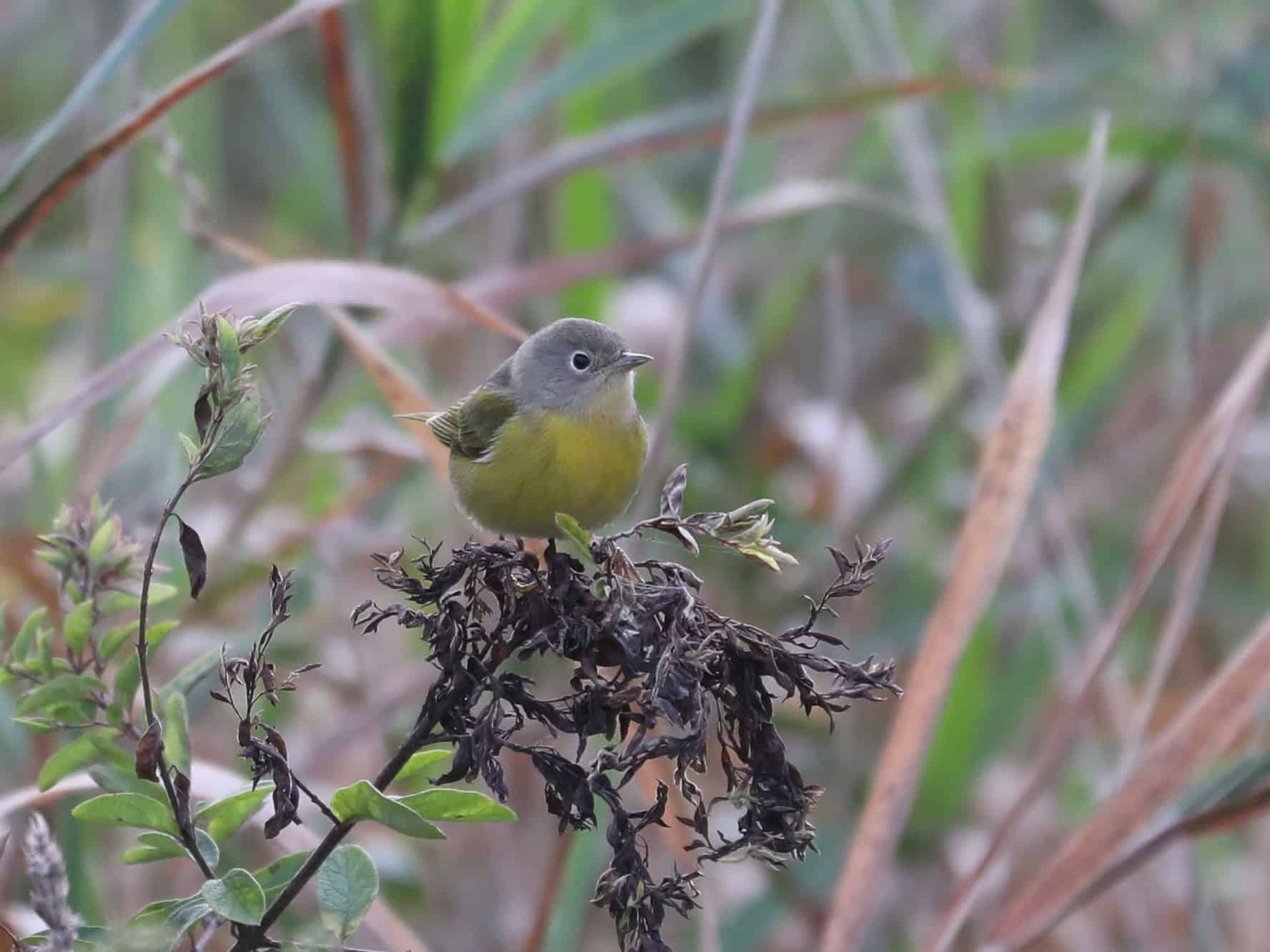
Nashville Warbler in York County (September 2022)

Virginia’s Warbler in Montgomery County (March 2026)
Life Bird: Virginia’s Warbler
When a birder sees a species of bird that they’ve never seen before, they call it a life bird. I’ve been birding in Pennsylvania now for more than three decades, and it’s gotten very difficult for me to see lifebirds in the state. That’s why I was so excited this weekend to learn that another birder had found a Virginia’s Warbler in Montgomery County. That’s not just a new bird for me – it’s the first time that species has ever been reported in Pennsylvania. Within minutes of arriving, I joined dozens of other birders as we enjoyed great looks at the little bird as it actively foraged in the bushes and vines of a hillside right next to the parking area.
Virginia’s Warblers are typically found nesting in steep-sloped, dry forest habitat in the Rocky Mountains, especially in the Four Corners states of Utah, Colorado, New Mexico, and Arizona. It migrates to southwestern Mexico during the winter. This species wasn’t discovered until just before the Civil War, and it remains one of the least studied warbler species in the United States. Long-distance migrants sometimes fly in the wrong direction. It’s likely that the Virginia’s Warbler visiting Pennsylvania arrived last fall after taking the wrong course in fall migration. If that’s the case, it’s remarkable it was able to survive the cold, snowy winter we just had.
There are a few close relatives of Virginia’s Warbler that you can find in Pennsylvania each year. It’s closest relative is the Nashville Warbler (also pictured), which nests in the northern half of Pennsylvania. The two species have a similar pattern of coloration, with yellow on the throat and beneath the tail, plus a subtle patch of dark orange on the crown of the male. Compared to Virginia’s, Nashville is more colorful, with a yellow breast and belly, as well as greenish wings. Nashville and Virginia’s Warblers are also in the same genus as Orange-crowned Warbler and Tennessee Warbler, both of which pass through each year during spring and fall migration.
The name of the Virginia’s Warbler has nothing to do with the state of Virginia. The man who discovered the species in New Mexico in 1858 requested that the bird be named after his wife. Virginia’s Warbler is one of five warblers that were named after women. The Blackburnian Warbler was named in 1785 for Anna Blackburne, an English botanist. In the 1860s, Grace’s Warbler was named for the discoverer’s sister, Lucy’s Warbler for the daughter of the discoverer’s friend, and Adelaide’s Warbler for the discoverer’s daughter. Adelaide’s Warbler could have had a much longer name, because that woman’s full name was a mouthful – Maria Antoinette Adelaide Florentia del Carmen Swift Washburne.
Nashville Warbler in York County (September 2022)


About The Author
Dan Hinnebusch is the Ornithologist for Wild Birds Unlimited. Click to learn more.
