

Mississippi Kite
A pair of Mississippi Kites have been living at Wildwood Lake Park near Harrisburg for the last two weeks. This species is rare in Pennsylvania, and birders have flocked from across the state to get a look. A few Mississippi Kites are seen in the state every year, but usually they are only seen briefly as they fly overhead. Having a pair living in the same location for weeks is a rare treat.
Mississippi Kite key facts
| Scientific name | Ictinia mississippiensis |
|---|---|
| Family | Accipitridae (Hawks, Eagles, and Kites) |
| Order | Accipitriformes |
| eBird species page | Mississippi Kite on eBird (code miskit) |
Fun fact: Unlike the raptors that are common in Pennsylvania, Mississippi Kites usually don't bother to perch after they catch prey. They bend their head down and eat while still flying.
Mississippi Kites are almost as long (bill to tail) as Peregrine Falcons, but the falcons weigh more than twice as much as the 8- or 9-ounce kites. Most Mississippi Kites subsist mostly on flying insects, especially beetles, grasshoppers, and cicadas. They will also take some vertebrate prey, including frogs, lizards, snakes, and rodents. They often build their nests next to wasp nests. The wasps don’t bother the kites, but they provide defense against predators like raccoons and fox squirrels that try to eat the kites’ eggs or nestlings.
Mississippi Kites nest across the southern United States, especially in the Southeast and in the southern Great Plains in Texas, Oklahoma, and Kansas. A small number nest as far north as Virginia and Maryland in the area surrounding Washington, DC. I saw one of these kites for the first time a few decades ago while visiting my aunt and uncle in El Paso, Texas. I got lucky a few years ago and had one fly overhead while I was conducting a bird survey in western Pennsylvania.
These kites are only present in the United States for about half the year, from April to September. They migrate thousands of miles to spend the winter in southern South America, in Paraguay and parts of southern Brazil and northern Argentina. On their southbound migration in fall, almost all Mississippi Kites will pass by the Veracruz migration watch site in Mexico, where observers record hundreds of thousands of Mississippi Kites each year. Counters at Veracruz once recorded more than 76 thousand in a single day! As a point of reference, counters at the famous Hawk Mountain Sanctuary watch site in Pennsylvania record fewer than 20 thousand hawks of all species in their entire four-month count.
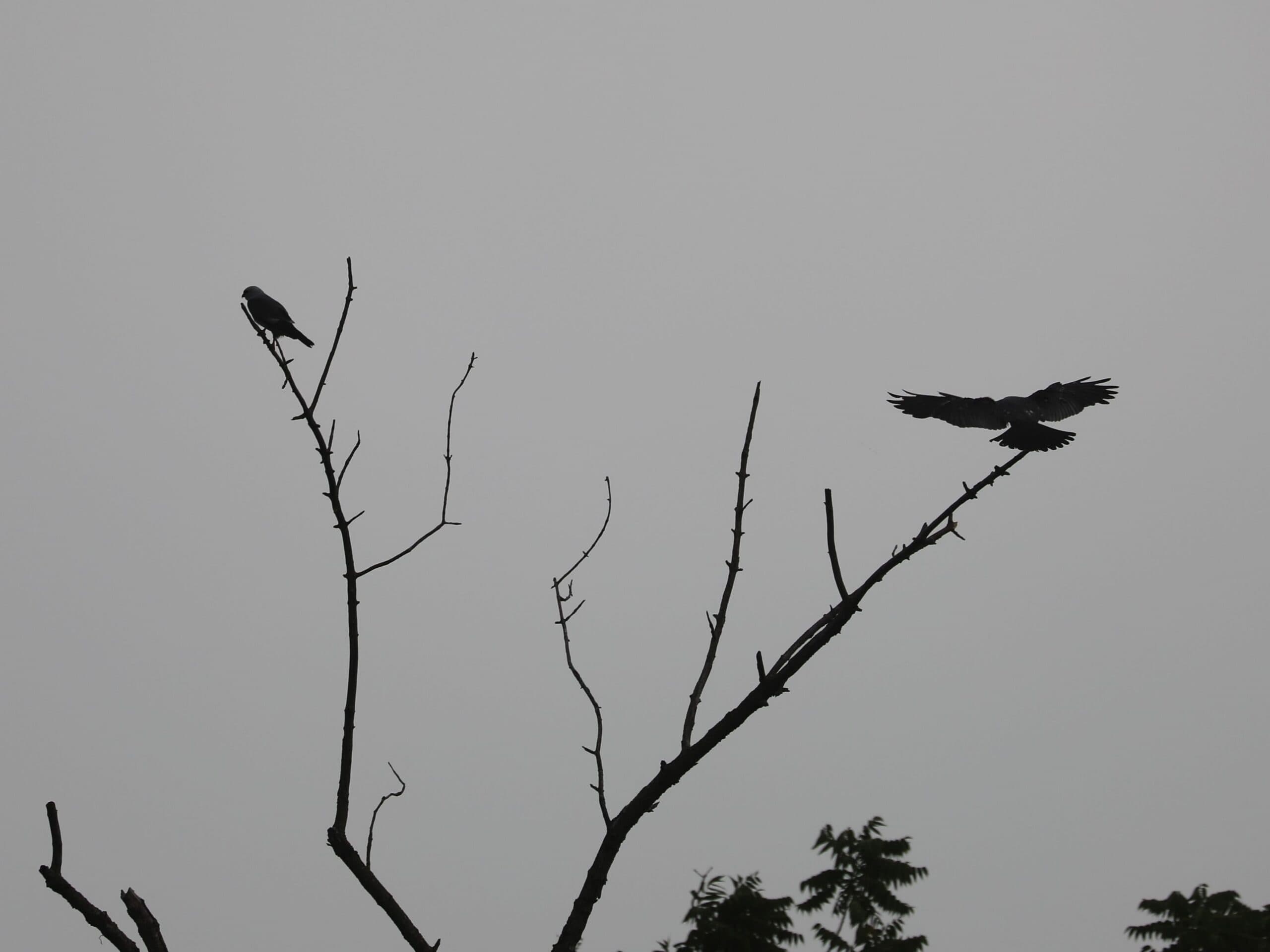
Mississippi Kites in Dauphin County (August 2026).

Mississippi Kites in Dauphin County (August 2026).
Mississippi Kite
A pair of Mississippi Kites have been living at Wildwood Lake Park near Harrisburg for the last two weeks. This species is rare in Pennsylvania, and birders have flocked from across the state to get a look. A few Mississippi Kites are seen in the state every year, but usually they are only seen briefly as they fly overhead. Having a pair living in the same location for weeks is a rare treat.
Mississippi Kite key facts
| Scientific name | Ictinia mississippiensis |
|---|---|
| Family | Accipitridae (Hawks, Eagles, and Kites) |
| Order | Accipitriformes |
| eBird species page | Mississippi Kite on eBird (code miskit) |
Fun fact: Unlike the raptors that are common in Pennsylvania, Mississippi Kites usually don't bother to perch after they catch prey. They bend their head down and eat while still flying.
Mississippi Kites are almost as long (bill to tail) as Peregrine Falcons, but the falcons weigh more than twice as much as the 8- or 9-ounce kites. Most Mississippi Kites subsist mostly on flying insects, especially beetles, grasshoppers, and cicadas. They will also take some vertebrate prey, including frogs, lizards, snakes, and rodents. They often build their nests next to wasp nests. The wasps don’t bother the kites, but they provide defense against predators like raccoons and fox squirrels that try to eat the kites’ eggs or nestlings.
Mississippi Kites nest across the southern United States, especially in the Southeast and in the southern Great Plains in Texas, Oklahoma, and Kansas. A small number nest as far north as Virginia and Maryland in the area surrounding Washington, DC. I saw one of these kites for the first time a few decades ago while visiting my aunt and uncle in El Paso, Texas. I got lucky a few years ago and had one fly overhead while I was conducting a bird survey in western Pennsylvania.
These kites are only present in the United States for about half the year, from April to September. They migrate thousands of miles to spend the winter in southern South America, in Paraguay and parts of southern Brazil and northern Argentina. On their southbound migration in fall, almost all Mississippi Kites will pass by the Veracruz migration watch site in Mexico, where observers record hundreds of thousands of Mississippi Kites each year. Counters at Veracruz once recorded more than 76 thousand in a single day! As a point of reference, counters at the famous Hawk Mountain Sanctuary watch site in Pennsylvania record fewer than 20 thousand hawks of all species in their entire four-month count.


About The Author
Dan Hinnebusch is the Ornithologist for Wild Birds Unlimited. Click to learn more.
