

American Oystercatcher
The American Oystercatcher is one of the most charismatic and distinctive birds inhabiting coastal habitats in the Americas. They live close to the ocean in South America, Central America, Mexico, most Caribbean islands, and on the eastern coast of the United States. The American Oystercatcher is one of twelve species of oystercatchers found worldwide. Six of those species look a lot like the American. The other six have almost entirely black plumage, including the Black Oystercatcher of western North America.
American Oystercatcher key facts
| Scientific name | Haematopus palliatus |
|---|---|
| Family | Haematopodidae (Oystercatchers) |
| Order | Charadriiformes |
| eBird species page | American Oystercatcher on eBird (code ameoys) |
Fun fact: Oystercatchers have a uniquely shaped bill that allows them to feed on bivalves like oysters, clams, and mussels.
Oystercatchers have a uniquely shaped bill that allows them to feed on bivalves like oysters, clams, and mussels. They use their sharp bill like a knife to quickly slice through the muscle that holds closed the two halves of the bivalve. With the muscle severed, the bivalve is unable to close the two halves of its shell, allowing the oystercatcher to eat its soft insides.
Although American Oystercatchers seem like a fairly common bird if you look in the right habitat, their population is surprisingly small. Based on a 2000 estimate, their nesting population in all of North America totals only about 10 thousand birds. For comparison, there are more than a dozen bird species in Pennsylvania with a nesting population greater than a million birds. The coasts of Virginia and the Carolinas are particularly important areas for oystercatchers. Biologists are currently researching American Oystercatchers to develop a plan to protect oystercatchers and their habitat.
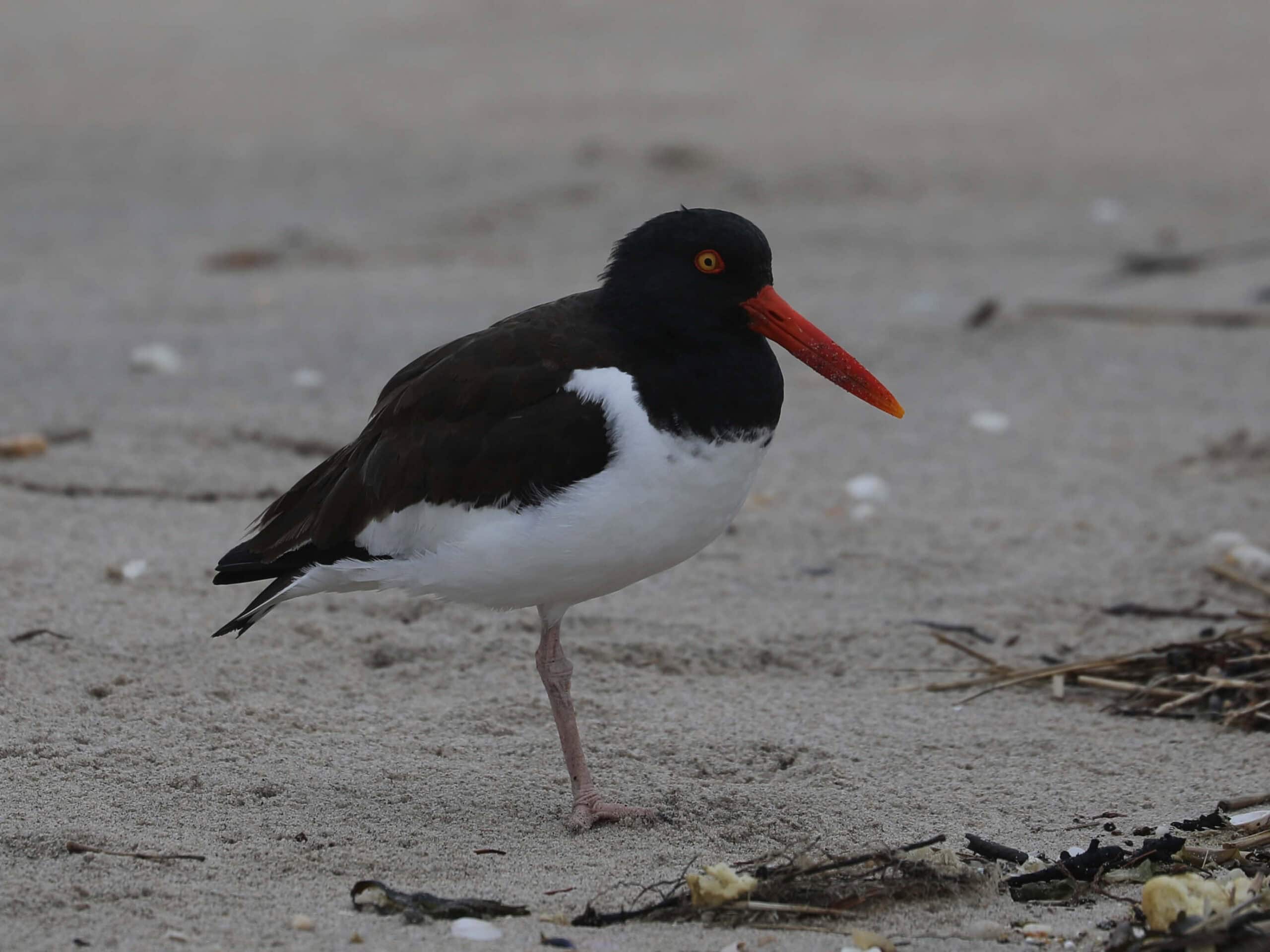
American Oystercatcher in New Jersey (April 2025)
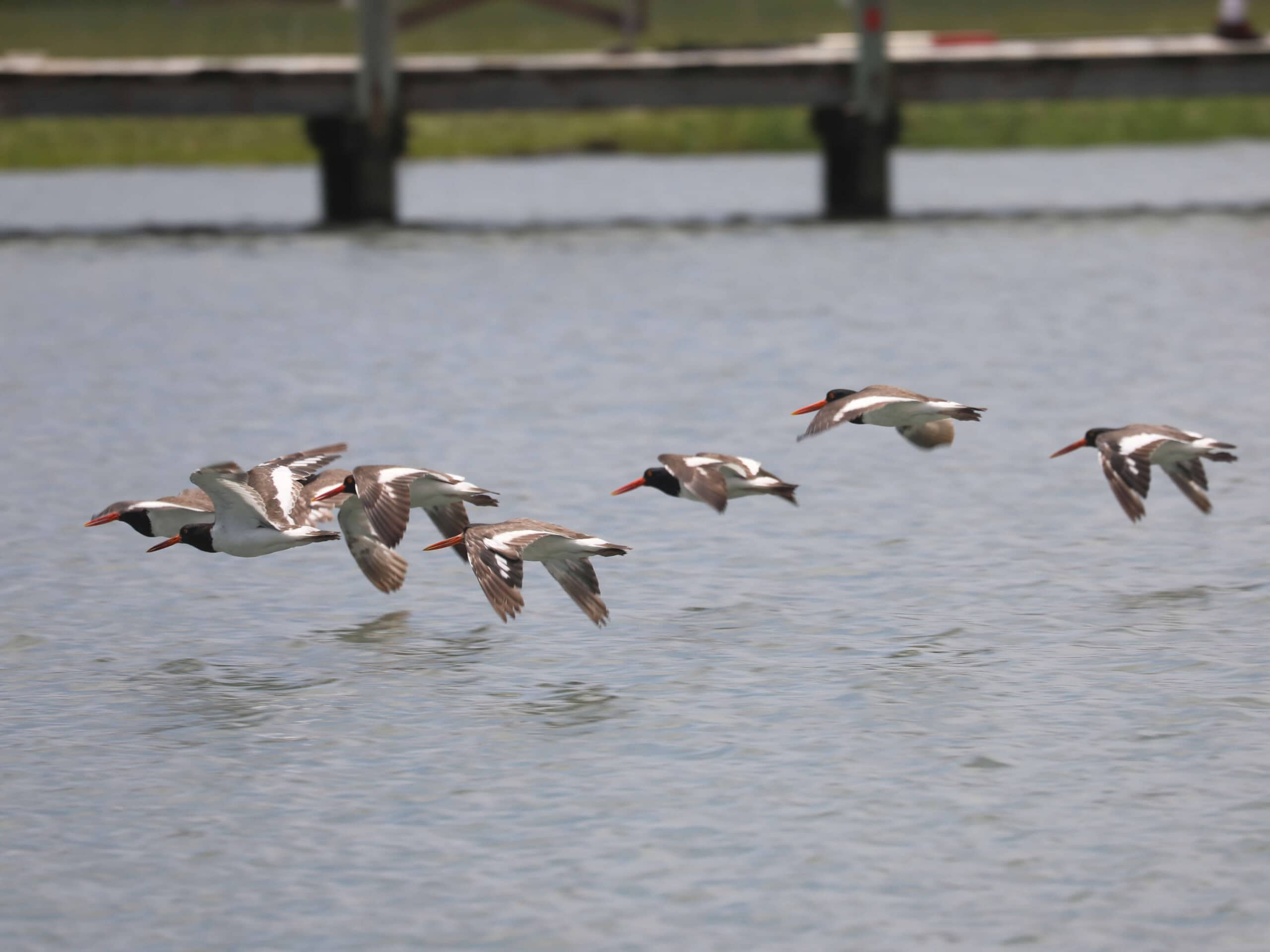
American Oystercatchers in Maryland (June 2026)

American Oystercatcher in New Jersey (April 2025)
American Oystercatcher
The American Oystercatcher is one of the most charismatic and distinctive birds inhabiting coastal habitats in the Americas. They live close to the ocean in South America, Central America, Mexico, most Caribbean islands, and on the eastern coast of the United States. The American Oystercatcher is one of twelve species of oystercatchers found worldwide. Six of those species look a lot like the American. The other six have almost entirely black plumage, including the Black Oystercatcher of western North America.
American Oystercatcher key facts
| Scientific name | Haematopus palliatus |
|---|---|
| Family | Haematopodidae (Oystercatchers) |
| Order | Charadriiformes |
| eBird species page | American Oystercatcher on eBird (code ameoys) |
Fun fact: Oystercatchers have a uniquely shaped bill that allows them to feed on bivalves like oysters, clams, and mussels.
Oystercatchers have a uniquely shaped bill that allows them to feed on bivalves like oysters, clams, and mussels. They use their sharp bill like a knife to quickly slice through the muscle that holds closed the two halves of the bivalve. With the muscle severed, the bivalve is unable to close the two halves of its shell, allowing the oystercatcher to eat its soft insides.
Although American Oystercatchers seem like a fairly common bird if you look in the right habitat, their population is surprisingly small. Based on a 2000 estimate, their nesting population in all of North America totals only about 10 thousand birds. For comparison, there are more than a dozen bird species in Pennsylvania with a nesting population greater than a million birds. The coasts of Virginia and the Carolinas are particularly important areas for oystercatchers. Biologists are currently researching American Oystercatchers to develop a plan to protect oystercatchers and their habitat.
American Oystercatchers in Maryland (June 2026)


About The Author
Dan Hinnebusch is the Ornithologist for Wild Birds Unlimited. Click to learn more.
