

Palm Warbler
Last week I wrote about Eastern Phoebes and mentioned their tail-pumping behavior. They persistently move their tail up and down like a kid who just can’t sit still. This week I came across a different kind of “tail-pumper” with a flock of Palm Warblers passing through on migration. Just like for the phoebe, the tail-pumping behavior of the Palm Warbler can be a really useful identification clue. There are no other warblers in eastern North America that tail-pump so regularly. Palm Warblers also spend more time on or near the ground than most other warblers.
Palm Warblers were first discovered on Hispaniola, the island shared by Haiti and the Dominican Republic, where there are many palm trees. Many Palm Warblers spend the winter on Caribbean Islands and in eastern Mexico, but the majority stay in the southeastern United States (a few may even winter as far north as southeastern Pennsylvania). In winter, they use more open habitats, unlike the forested habitats preferred by most types of warblers. During the summer, they fly farther north than almost any other species of warbler. They nest in bogs within the vast coniferous forests of Canada, far from the nearest palm tree.
Palm Warblers are fairly common with an estimated population of about 13 million. Unfortunately, they do face several threats. They appear to be particularly susceptible to collisions with cell phone towers and other tall structures with lights. Hundreds can be found dead around some towers after a single night during the peak of migration. Additionally, fragmentation of forests in Canada for timber harvesting and peat mining exposes this ground-nesting species and its eggs to predation by raccoons, grackles, and crows. Surprisingly, forest clearing in the Palm Warbler’s winter range may actually benefit this species due to its preference for less forested habitat during that time of year.
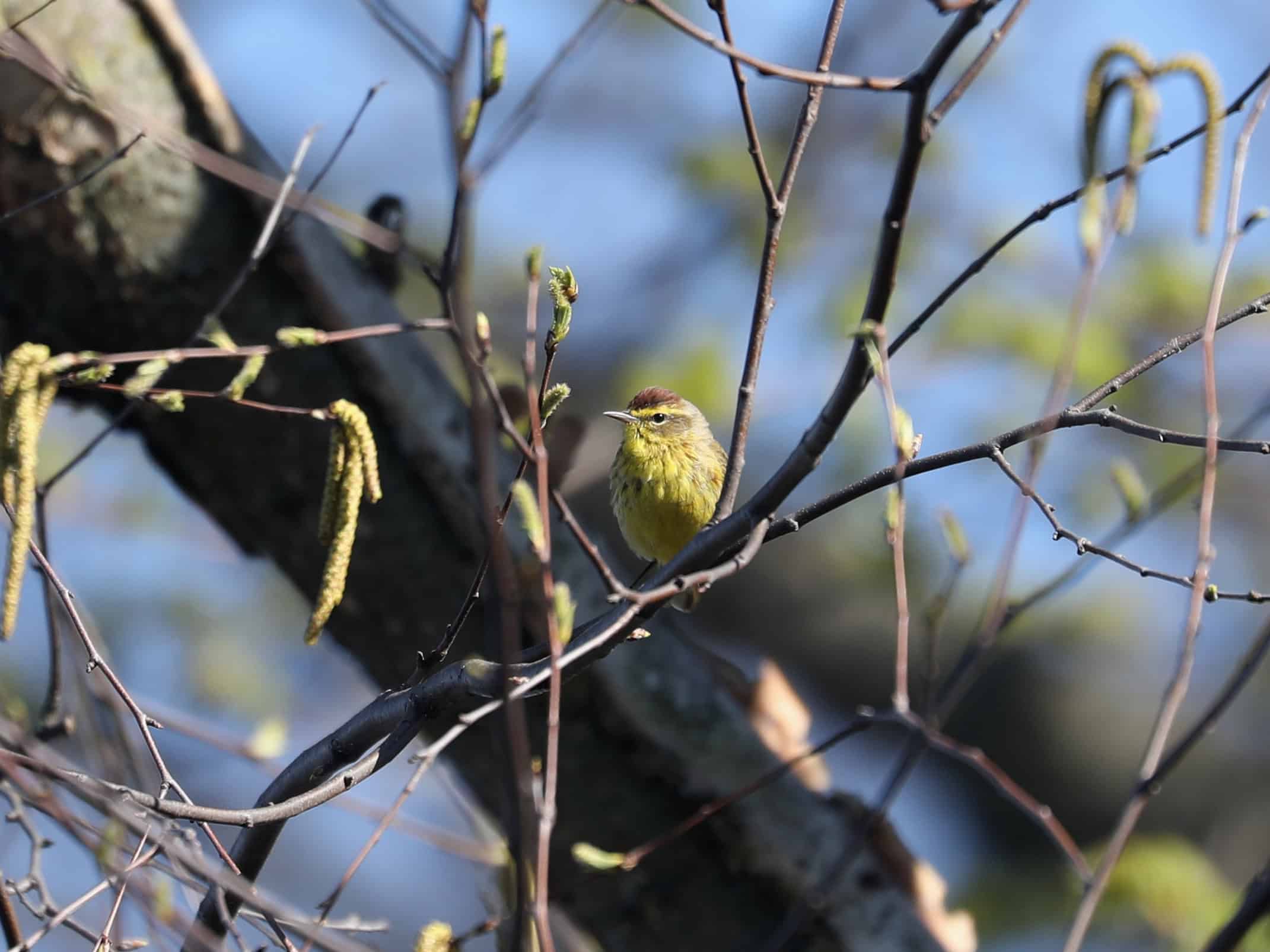
Palm Warbler in York County (April 2026)

Palm Warbler in Lebanon County (April 2024)

Palm Warbler in York County (April 2026)
Palm Warbler
Last week I wrote about Eastern Phoebes and mentioned their tail-pumping behavior. They persistently move their tail up and down like a kid who just can’t sit still. This week I came across a different kind of “tail-pumper” with a flock of Palm Warblers passing through on migration. Just like for the phoebe, the tail-pumping behavior of the Palm Warbler can be a really useful identification clue. There are no other warblers in eastern North America that tail-pump so regularly. Palm Warblers also spend more time on or near the ground than most other warblers.
Palm Warblers were first discovered on Hispaniola, the island shared by Haiti and the Dominican Republic, where there are many palm trees. Many Palm Warblers spend the winter on Caribbean Islands and in eastern Mexico, but the majority stay in the southeastern United States (a few may even winter as far north as southeastern Pennsylvania). In winter, they use more open habitats, unlike the forested habitats preferred by most types of warblers. During the summer, they fly farther north than almost any other species of warbler. They nest in bogs within the vast coniferous forests of Canada, far from the nearest palm tree.
Palm Warblers are fairly common with an estimated population of about 13 million. Unfortunately, they do face several threats. They appear to be particularly susceptible to collisions with cell phone towers and other tall structures with lights. Hundreds can be found dead around some towers after a single night during the peak of migration. Additionally, fragmentation of forests in Canada for timber harvesting and peat mining exposes this ground-nesting species and its eggs to predation by raccoons, grackles, and crows. Surprisingly, forest clearing in the Palm Warbler’s winter range may actually benefit this species due to its preference for less forested habitat during that time of year.
Palm Warbler in Lebanon County (April 2024)


About The Author
Dan Hinnebusch is the Ornithologist for Wild Birds Unlimited. Click to learn more.
