

Rough-legged Hawk
I came across one of my favorite birds while driving west on PA-283 this week. I was pretty sure I saw a Rough-legged Hawk perched near the highway, but I couldn’t safely stop. After reaching the next exit, I worked my way back east on the back roads and was rewarded with great views of this Arctic beauty.
Rough-legged Hawks nest across most of the Arctic Circle in the tundra of northern Canada and northern Alaska. You can also find them in Scandinavia and northern Russia. Throughout their nesting range, they hunt small mammals like lemmings and voles in open, treeless habitat. They build nests on cliffs or occasionally on artificial structures like communication towers and buildings. They live so far north that the sun never sets during their breeding season.
When winter approaches, Rough-legged Hawks migrate south. They fly past the dense coniferous forests of Canada and seek open, treeless habitats more similar to the tundra where they breed. They wait out the winter in southern Canada and across much of the United States. They’re scarce here in Pennsylvania, because most Rough-legged Hawks in eastern North America stay farther north in Quebec, Ontario, and Michigan.
Like other birds, Rough-legged Hawks need to eat a lot of food to keep their metabolism fueled to keep their body warm. They need about five small mammals each day to survive. There is some evidence that they can see the ultraviolet light that reflects off the urine of rodents so they can focus their hunting in areas with large rodent populations. While they’re here in the Susquehanna Valley, Rough-legged Hawks spend most of their time perched on the tiny upper branches of isolated trees surrounded by large fields. They watch for prey from their high perch. They will also sometimes hover in place above fields, flapping like an American Kestrel. If snow cover makes rodents difficult to find, they may eat carrion like road-killed deer.
Rough-legged Hawks are closely related to three hawk species that nest in Pennsylvania: Red-tailed Hawk, Red-shouldered Hawk, and Broad-winged Hawk. They are one of three hawk species in North America that are “booted,” meaning that their legs are feathered down to their toes. The other two booted hawks are the Golden Eagle and the Ferruginous Hawk.

Rough-legged Hawk in Lancaster County (February 2026)
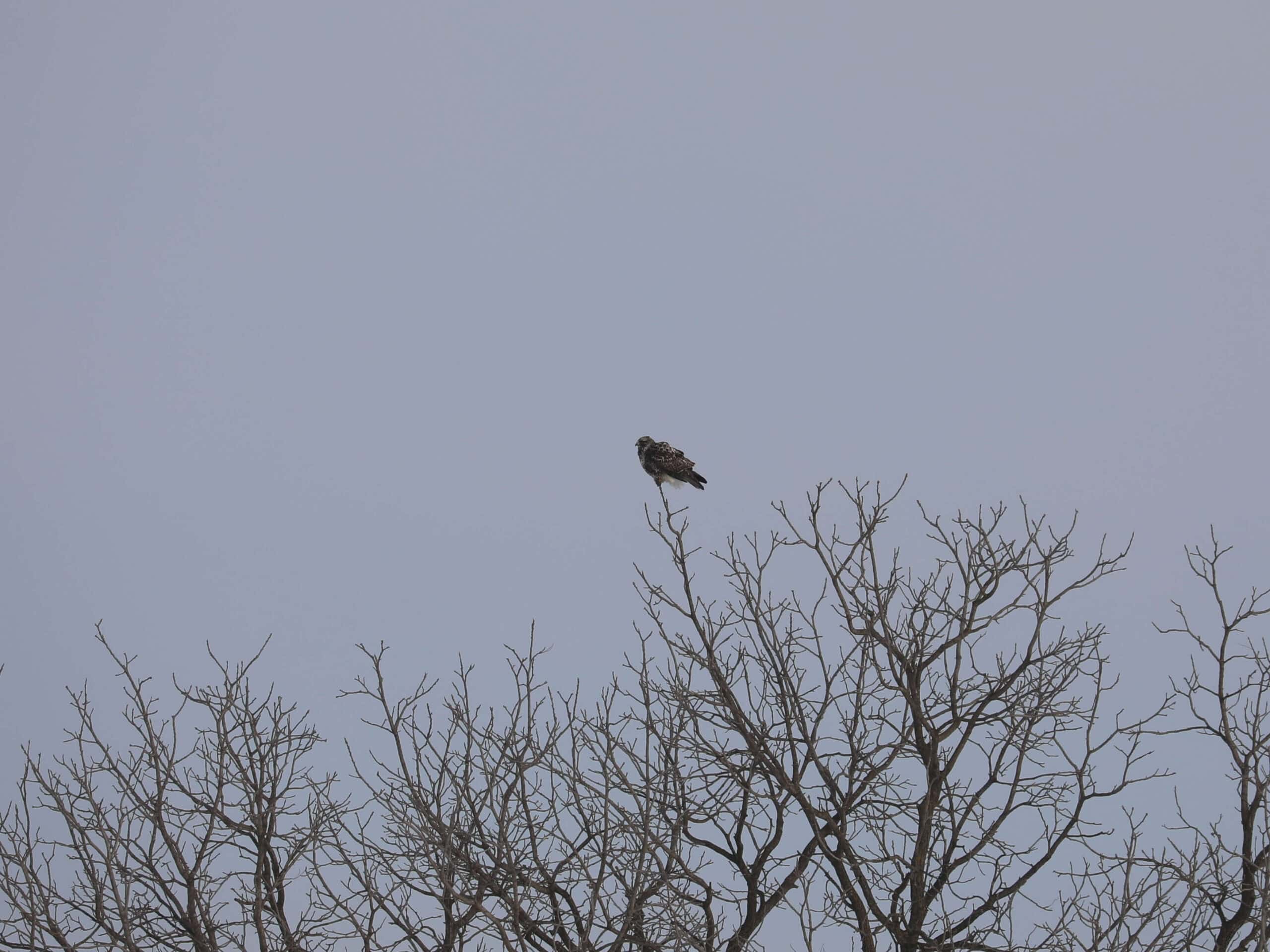
Rough-legged Hawk perched high in a tree in Lancaster County (February 2026)

Rough-legged Hawk in Lancaster County (February 2026)
Rough-legged Hawk
I came across one of my favorite birds while driving west on PA-283 this week. I was pretty sure I saw a Rough-legged Hawk perched near the highway, but I couldn’t safely stop. After reaching the next exit, I worked my way back east on the back roads and was rewarded with great views of this Arctic beauty.
Rough-legged Hawks nest across most of the Arctic Circle in the tundra of northern Canada and northern Alaska. You can also find them in Scandinavia and northern Russia. Throughout their nesting range, they hunt small mammals like lemmings and voles in open, treeless habitat. They build nests on cliffs or occasionally on artificial structures like communication towers and buildings. They live so far north that the sun never sets during their breeding season.
When winter approaches, Rough-legged Hawks migrate south. They fly past the dense coniferous forests of Canada and seek open, treeless habitats more similar to the tundra where they breed. They wait out the winter in southern Canada and across much of the United States. They’re scarce here in Pennsylvania, because most Rough-legged Hawks in eastern North America stay farther north in Quebec, Ontario, and Michigan.
Like other birds, Rough-legged Hawks need to eat a lot of food to keep their metabolism fueled to keep their body warm. They need about five small mammals each day to survive. There is some evidence that they can see the ultraviolet light that reflects off the urine of rodents so they can focus their hunting in areas with large rodent populations. While they’re here in the Susquehanna Valley, Rough-legged Hawks spend most of their time perched on the tiny upper branches of isolated trees surrounded by large fields. They watch for prey from their high perch. They will also sometimes hover in place above fields, flapping like an American Kestrel. If snow cover makes rodents difficult to find, they may eat carrion like road-killed deer.
Rough-legged Hawks are closely related to three hawk species that nest in Pennsylvania: Red-tailed Hawk, Red-shouldered Hawk, and Broad-winged Hawk. They are one of three hawk species in North America that are “booted,” meaning that their legs are feathered down to their toes. The other two booted hawks are the Golden Eagle and the Ferruginous Hawk.
Rough-legged Hawk perched high in a tree in Lancaster County (February 2026)


About The Author
Dan Hinnebusch is the Ornithologist for Wild Birds Unlimited. Click to learn more.
