

Virginia Rails
Have you heard the expression “thin as a rail?” Most people think the word rail refers to a metal or wooden pole, but it is actually based on a bird called a rail. Most of the world’s 150+ species of rails are “laterally compressed,” meaning that they have a very thin profile if you look at them head-on. That shape helps them push through dense wetland vegetation like cattails. I found a few Virginia Rails a few months ago in a large wetland in western Pennsylvania. In addition to their laterally compressed shape, Virginia Rails are further adapted for squeezing through tight vegetation with a flexible backbone and durable feathers on the front of their head to resist wear. Additionally, they have long toes to distribute their weight, allowing them to more easily walk on soft mud and floating vegetation.
Virginia Rails are not rare in Pennsylvania, but seeing one is always special. They are more often heard than seen, because they are secretive and rarely emerge from thick vegetation where they live. If you find a rail out in the open, they will usually run back into hiding. They may also dive under water to escape, using their wings as paddles.
Because they are so hard to observe, we still don’t know many of the details of how Virginia Rails live. We do know that they are monogamous, and that they build several “dummy” nests in addition to the nest in which they lay their eggs. Usually they lay 8 or 9 speckled eggs, but they have been known to lay as many as 13. The young are precocial, meaning they are able to leave the nest within hours of hatching. They can’t fly yet, but they have a full coat of fluffly black down feathers and they can follow their parents and learn how to find food.
To find these sneaky birds, your best chance is to learn their grunting calls. Visit a large wetland at dawn or dusk, when they’re most active. You’ll be looking for a mostly brown, gray-faced bird with a long red bill. They measure about 9 to 10 inches in length, which is slightly smaller than a Blue Jay. In the Susquehanna Valley you’ll need to search in spring, summer, or fall, because they migrate to wetlands closer to the Atlantic Ocean during winter.
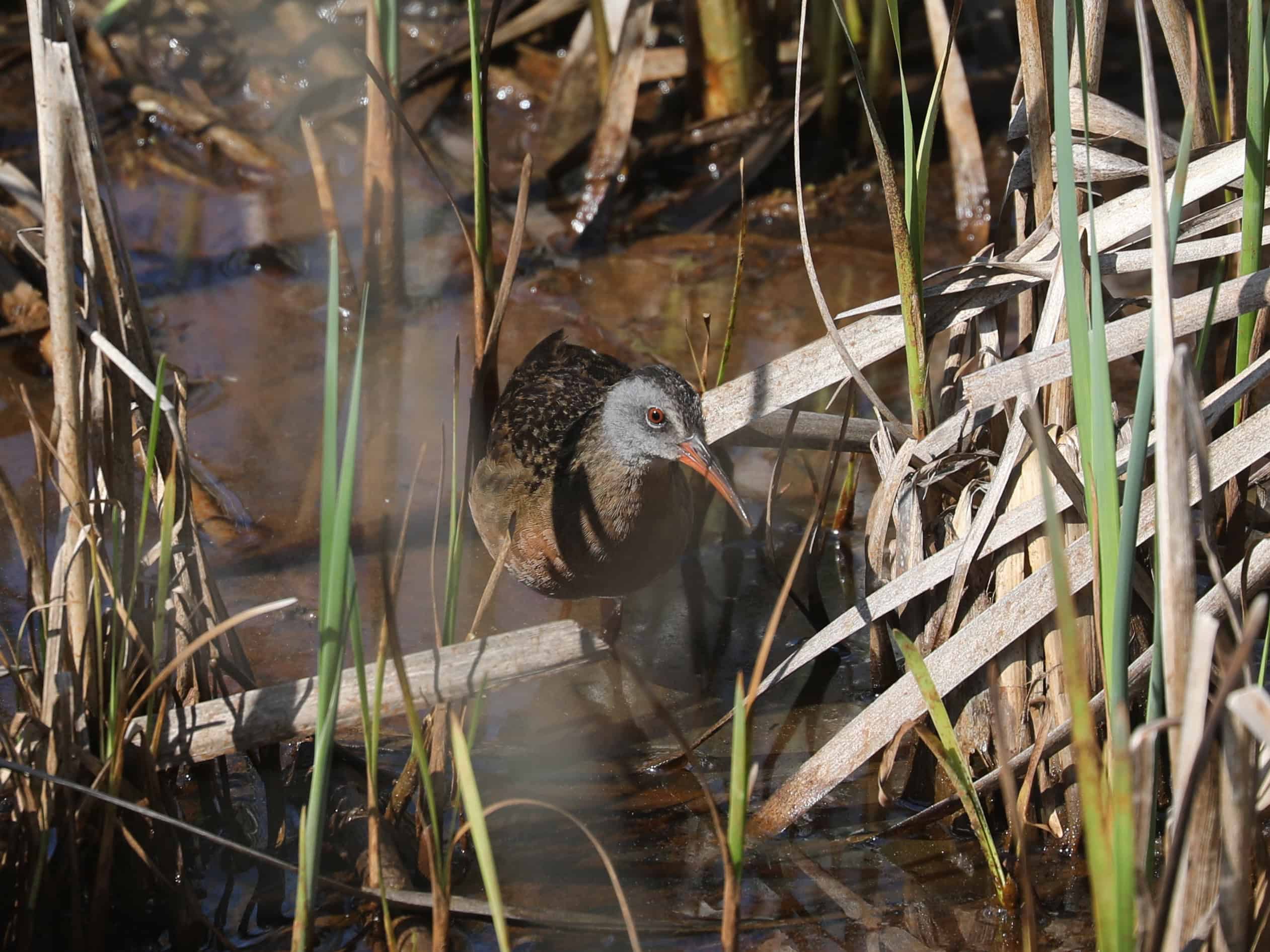
Virginia Rail in Mercer County (May 2025)
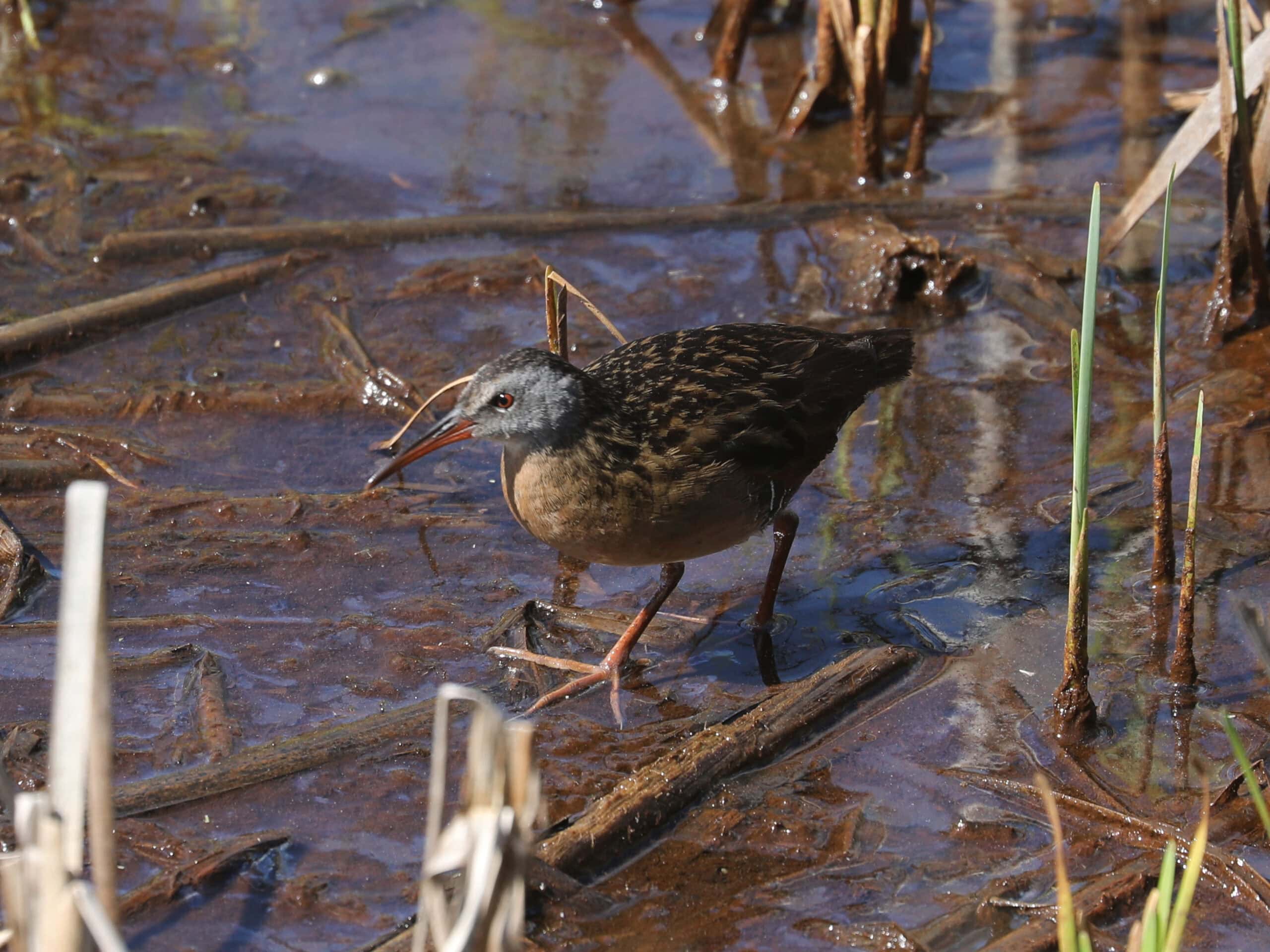
Virginia Rail in Mercer County (May 2025)

Virginia Rail in Mercer County (May 2025)
Virginia Rails
Have you heard the expression “thin as a rail?” Most people think the word rail refers to a metal or wooden pole, but it is actually based on a bird called a rail. Most of the world’s 150+ species of rails are “laterally compressed,” meaning that they have a very thin profile if you look at them head-on. That shape helps them push through dense wetland vegetation like cattails. I found a few Virginia Rails a few months ago in a large wetland in western Pennsylvania. In addition to their laterally compressed shape, Virginia Rails are further adapted for squeezing through tight vegetation with a flexible backbone and durable feathers on the front of their head to resist wear. Additionally, they have long toes to distribute their weight, allowing them to more easily walk on soft mud and floating vegetation.
Virginia Rails are not rare in Pennsylvania, but seeing one is always special. They are more often heard than seen, because they are secretive and rarely emerge from thick vegetation where they live. If you find a rail out in the open, they will usually run back into hiding. They may also dive under water to escape, using their wings as paddles.
Because they are so hard to observe, we still don’t know many of the details of how Virginia Rails live. We do know that they are monogamous, and that they build several “dummy” nests in addition to the nest in which they lay their eggs. Usually they lay 8 or 9 speckled eggs, but they have been known to lay as many as 13. The young are precocial, meaning they are able to leave the nest within hours of hatching. They can’t fly yet, but they have a full coat of fluffly black down feathers and they can follow their parents and learn how to find food.
To find these sneaky birds, your best chance is to learn their grunting calls. Visit a large wetland at dawn or dusk, when they’re most active. You’ll be looking for a mostly brown, gray-faced bird with a long red bill. They measure about 9 to 10 inches in length, which is slightly smaller than a Blue Jay. In the Susquehanna Valley you’ll need to search in spring, summer, or fall, because they migrate to wetlands closer to the Atlantic Ocean during winter.
Virginia Rail in Mercer County (May 2025)


About The Author
Dan Hinnebusch is the Ornithologist for Wild Birds Unlimited. Click to learn more.