

Yellow-bellied Sapsucker
Pennsylvania is home to seven species of woodpeckers, and six of them can be found year-round in the Susquehanna Valley. The seventh is the Yellow-bellied Sapsucker, a migratory species that nests farther to the north. Sapsuckers nest across the northernmost third of the state. They arrive in the Susquehanna Valley on fall migration in September, and they’re fairly common in our area until mid-April. Overall, they are doing quite well in Pennsylvania, with a breeding population five times greater than in the 1960s.
The easiest way to identify a Yellow-bellied Sapsucker is by the vertical white stripe on each folded wing (it’s barely visible in these two photos). Adult male sapsuckers have a patch of red feathers on the top of their head, plus a red throat. Females look almost the same, but with a white throat. The feathers of immature sapsuckers are mostly mottled brown, with black and white wing and tail feathers. A sapsucker with mottled brown feathers is less than a year old. Young sapsuckers will replace those brown feathers by molting in May or June. They’ll have their first set of adult feathers in time for their first nesting season as adults.
If you have some larger trees in your yard, you probably have sapsuckers visiting during the winter. Watch for them on the trunks or large branches of trees. They also visit bird feeders. Like other woodpeckers, their favorite foods include Bark Butter, Bark Butter Bits, suet, peanuts, and tree nuts like walnuts, almonds, pistachios, and cashews. Some seed blends like No-Mess Plus and TreeNutty Plus offer many of those ingredients together in one bag.

The mottled brown feathers of this immature Yellow-bellied Sapsucker provide camouflage against the bark of many trees (January 2026)
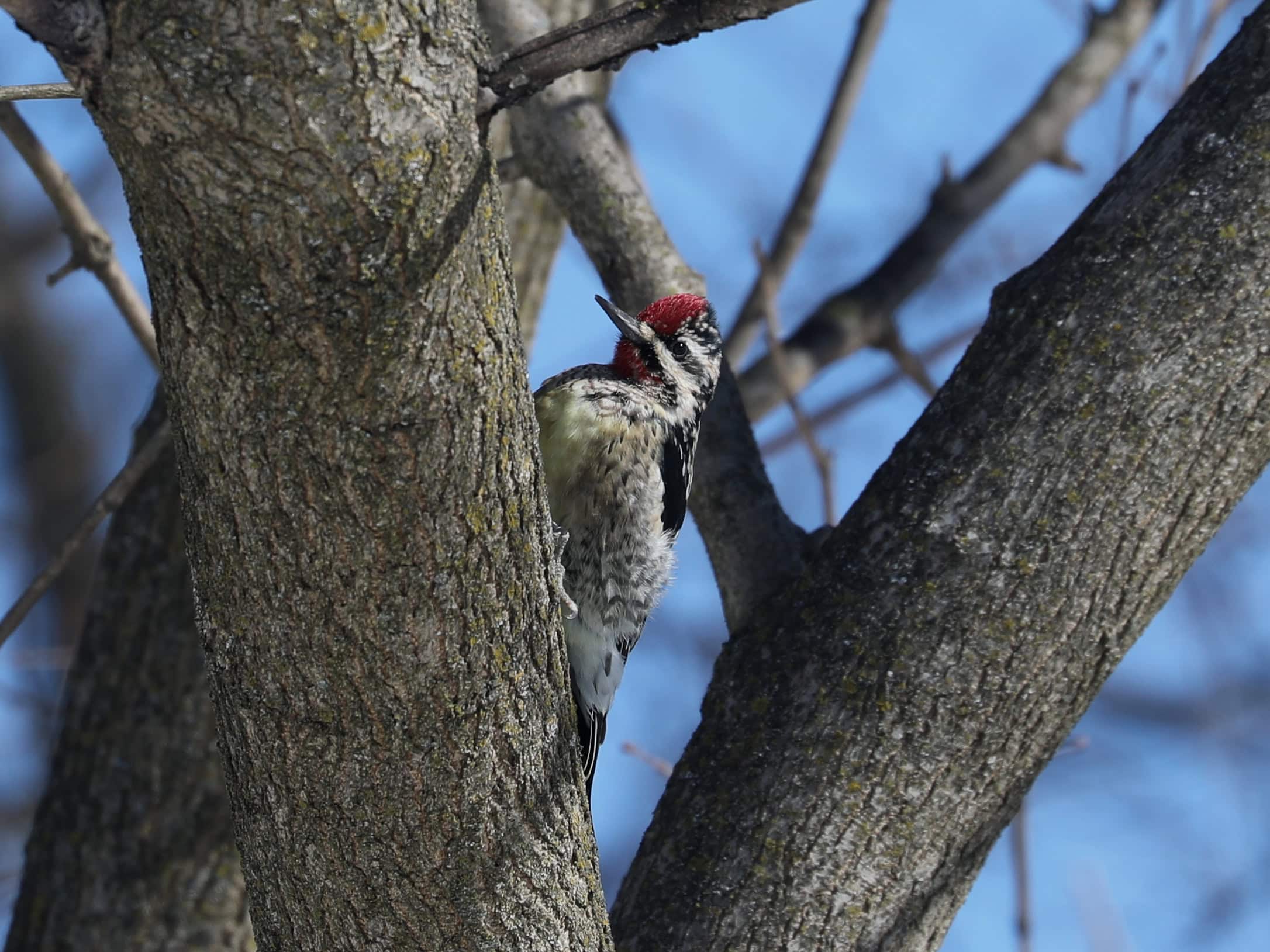
Its red throat indicates this Yellow-bellied Sapsucker is an adult male (January 2026)

The mottled brown feathers of this immature Yellow-bellied Sapsucker provide camouflage against the bark of many trees (January 2026)
Yellow-bellied Sapsucker
Pennsylvania is home to seven species of woodpeckers, and six of them can be found year-round in the Susquehanna Valley. The seventh is the Yellow-bellied Sapsucker, a migratory species that nests farther to the north. Sapsuckers nest across the northernmost third of the state. They arrive in the Susquehanna Valley on fall migration in September, and they’re fairly common in our area until mid-April. Overall, they are doing quite well in Pennsylvania, with a breeding population five times greater than in the 1960s.
The easiest way to identify a Yellow-bellied Sapsucker is by the vertical white stripe on each folded wing (it’s barely visible in these two photos). Adult male sapsuckers have a patch of red feathers on the top of their head, plus a red throat. Females look almost the same, but with a white throat. The feathers of immature sapsuckers are mostly mottled brown, with black and white wing and tail feathers. A sapsucker with mottled brown feathers is less than a year old. Young sapsuckers will replace those brown feathers by molting in May or June. They’ll have their first set of adult feathers in time for their first nesting season as adults.
If you have some larger trees in your yard, you probably have sapsuckers visiting during the winter. Watch for them on the trunks or large branches of trees. They also visit bird feeders. Like other woodpeckers, their favorite foods include Bark Butter, Bark Butter Bits, suet, peanuts, and tree nuts like walnuts, almonds, pistachios, and cashews. Some seed blends like No-Mess Plus and TreeNutty Plus offer many of those ingredients together in one bag.
Its red throat indicates this Yellow-bellied Sapsucker is an adult male (January 2026)


About The Author
Dan Hinnebusch is the Ornithologist for Wild Birds Unlimited. Click to learn more.
