

Winter Blackbird Flocks
Our local blackbirds spend most of the winter in farm fields. The flocks sometimes number in the tens of thousands, primarily a mix of three native blackbird species (Red-winged Blackbirds, Common Grackles, and Brown-headed Cowbirds) as well as non-native European Starlings (starlings are not members of the blackbird family, but you often find them flocking with blackbirds). Winter blackbird flocks travel in groups to eat up corn and other grains that were lost on the ground during the fall harvest. At night they roost in patches of forest near farm fields. If snow or ice covers the ground, many of these blackbirds find their way back to our yards to visit the bird feeders in large numbers.
Common Grackle key facts
| Scientific name | Quiscalus quiscula |
|---|---|
| Family | Icteridae (Troupials and Allies) |
| Order | Passeriformes |
| eBird species page | Common Grackle on eBird (code comgra) |
Fun fact: Common Grackles are also a major agricultural pest, causing tens of millions of dollars of damage each year, especially to corn.
Red-winged Blackbird key facts
| Scientific name | Agelaius phoeniceus |
|---|---|
| Family | Icteridae (Troupials and Allies) |
| Order | Passeriformes |
| eBird species page | Red-winged Blackbird on eBird (code rewbla) |
Fun fact: A single male Red-winged Blackbird can have up to 15 females nesting in his territory, yet up to half the nestlings are sired by other males. Source
I spent some time watching this large flock of blackbirds a few weeks ago. It’s mesmerizing to see such a large group of birds taking off together and circling in unison. With such a large flock, you can occasionally find less common blackbird species like Rusty Blackbirds, or even blackbirds that are usually found in the western United States, like Yellow-headed Blackbirds and Brewer’s Blackbirds. I didn’t see any rare birds this time.
The most exciting part of that birding outing was the end, when a pair of Peregrine Falcons swooped into view. The entire flock of blackbirds took off together, avoiding the falcons as each made several attempts to capture a blackbird. Within a few minutes, there wasn’t a blackbird in sight as the flock disappeared over a nearby hill. The unsuccessful falcons perched in a distant tree, resting up for future hunting attempts.
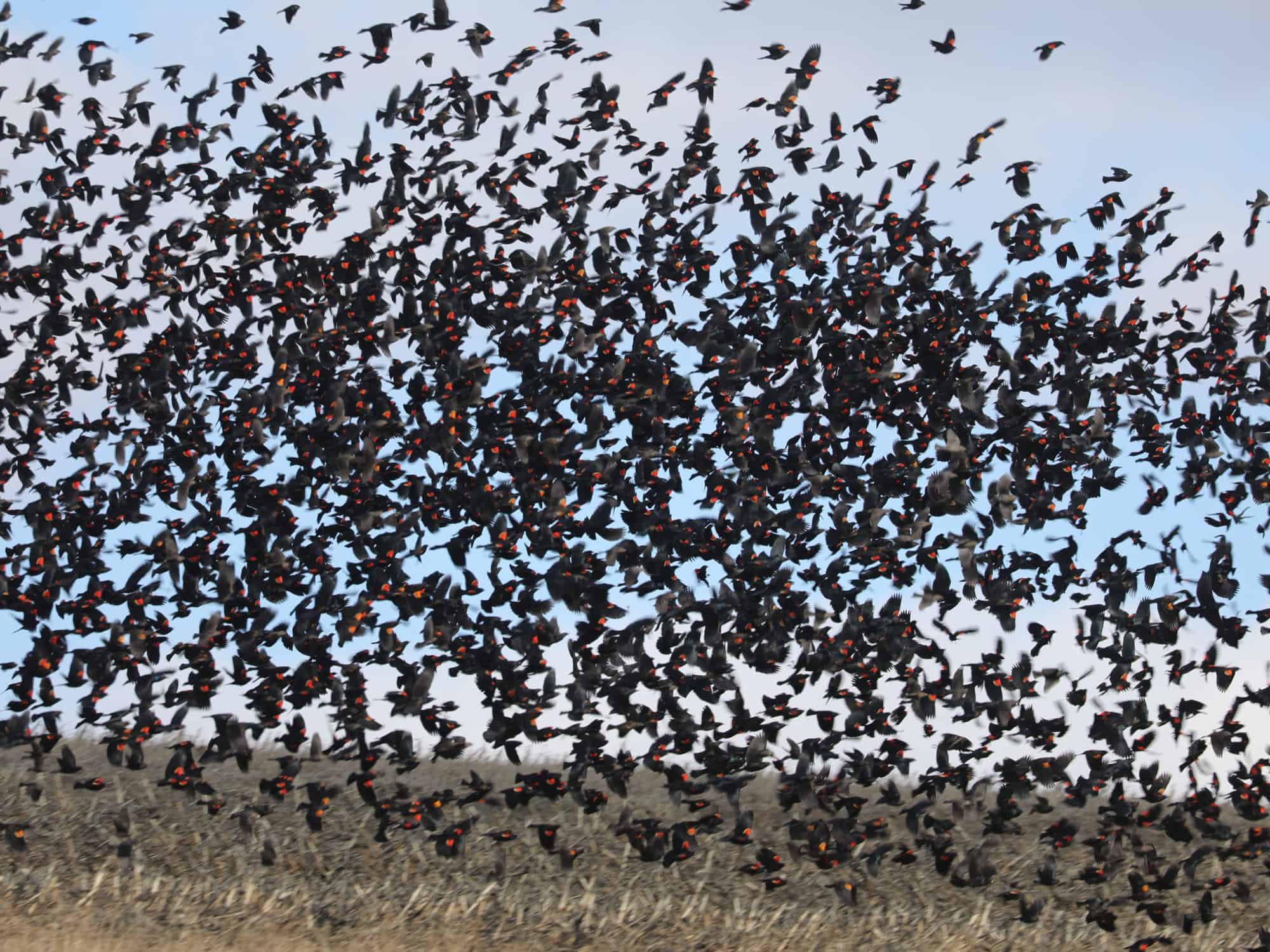
Red-winged Blackbirds, Common Grackles, Brown-headed Cowbirds, and European Starlings in Lancaster County (February 2025)
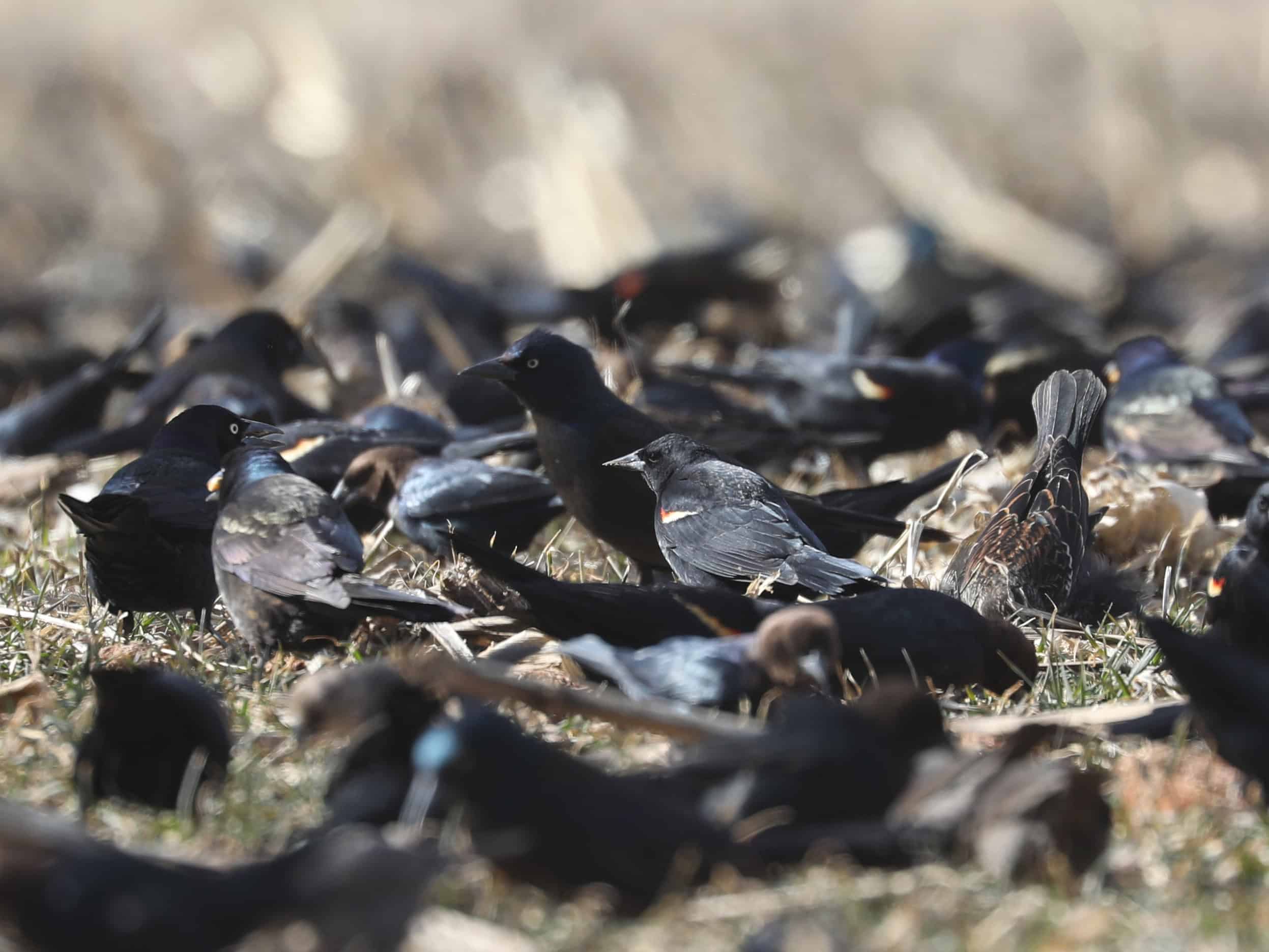
Red-winged Blackbirds, Common Grackles, and Brown-headed Cowbirds in Lancaster County (January 2016)

Red-winged Blackbirds, Common Grackles, Brown-headed Cowbirds, and European Starlings in Lancaster County (February 2025)
Winter Blackbird Flocks
Our local blackbirds spend most of the winter in farm fields. The flocks sometimes number in the tens of thousands, primarily a mix of three native blackbird species (Red-winged Blackbirds, Common Grackles, and Brown-headed Cowbirds) as well as non-native European Starlings (starlings are not members of the blackbird family, but you often find them flocking with blackbirds). Winter blackbird flocks travel in groups to eat up corn and other grains that were lost on the ground during the fall harvest. At night they roost in patches of forest near farm fields. If snow or ice covers the ground, many of these blackbirds find their way back to our yards to visit the bird feeders in large numbers.
Common Grackle key facts
| Scientific name | Quiscalus quiscula |
|---|---|
| Family | Icteridae (Troupials and Allies) |
| Order | Passeriformes |
| eBird species page | Common Grackle on eBird (code comgra) |
Fun fact: Common Grackles are also a major agricultural pest, causing tens of millions of dollars of damage each year, especially to corn.
Red-winged Blackbird key facts
| Scientific name | Agelaius phoeniceus |
|---|---|
| Family | Icteridae (Troupials and Allies) |
| Order | Passeriformes |
| eBird species page | Red-winged Blackbird on eBird (code rewbla) |
Fun fact: A single male Red-winged Blackbird can have up to 15 females nesting in his territory, yet up to half the nestlings are sired by other males. Source
I spent some time watching this large flock of blackbirds a few weeks ago. It’s mesmerizing to see such a large group of birds taking off together and circling in unison. With such a large flock, you can occasionally find less common blackbird species like Rusty Blackbirds, or even blackbirds that are usually found in the western United States, like Yellow-headed Blackbirds and Brewer’s Blackbirds. I didn’t see any rare birds this time.
The most exciting part of that birding outing was the end, when a pair of Peregrine Falcons swooped into view. The entire flock of blackbirds took off together, avoiding the falcons as each made several attempts to capture a blackbird. Within a few minutes, there wasn’t a blackbird in sight as the flock disappeared over a nearby hill. The unsuccessful falcons perched in a distant tree, resting up for future hunting attempts.
Red-winged Blackbirds, Common Grackles, and Brown-headed Cowbirds in Lancaster County (January 2016)


About The Author
Dan Hinnebusch is the Ornithologist for Wild Birds Unlimited. Learn more about Dan Hinnebusch.
