

Flocks: Pros & Cons
Why do some birds group together in flocks while others spend more time alone? It often comes down to two main factors – what they eat, and what eats them.
American Crow key facts
| Scientific name | Corvus brachyrhynchos |
|---|---|
| Family | Corvidae (Crows, Jays, and Magpies) |
| Order | Passeriformes |
| eBird species page | American Crow on eBird (code amecro) |
The main benefit that most birds gain from living in flocks is a reduced risk of being captured by a predator. They’re protected in four ways:
- Dilution – Each bird in a flock has a lower chance of being captured by a predator just because there are so many other options for a predator to choose.
- Confusion – Predators usually try to single out an individual to capture. The complicated movements of the flock make it hard to stay on target.
- Vigilance – Birds in flocks can spend more time searching for food and less time scanning for predators. As long as a few birds are watching, they can alert the entire flock when danger is detected.
- Defense – Some flocks gang up on predators to chase them off.
Birds in flocks also have an easier time finding food, when food is abundant but clumped in limited locations. For example, blackbirds find grain and other seeds in agricultural fields during the winter, or sandpipers may find a beach teeming with small insects to eat. Birds get this benefit in locations where there is so much food that the whole flock can eat.
Flocking doesn’t come without some disadvantages. If there’s not quite enough food to feed a flock, the flock members will start competing with each other, and some will break off alone or in smaller flocks to look for food elsewhere. If food is very scarce or too spread out, then flocks may never form in the first place. Flocks also increase the spread of diseases and parasites among birds.
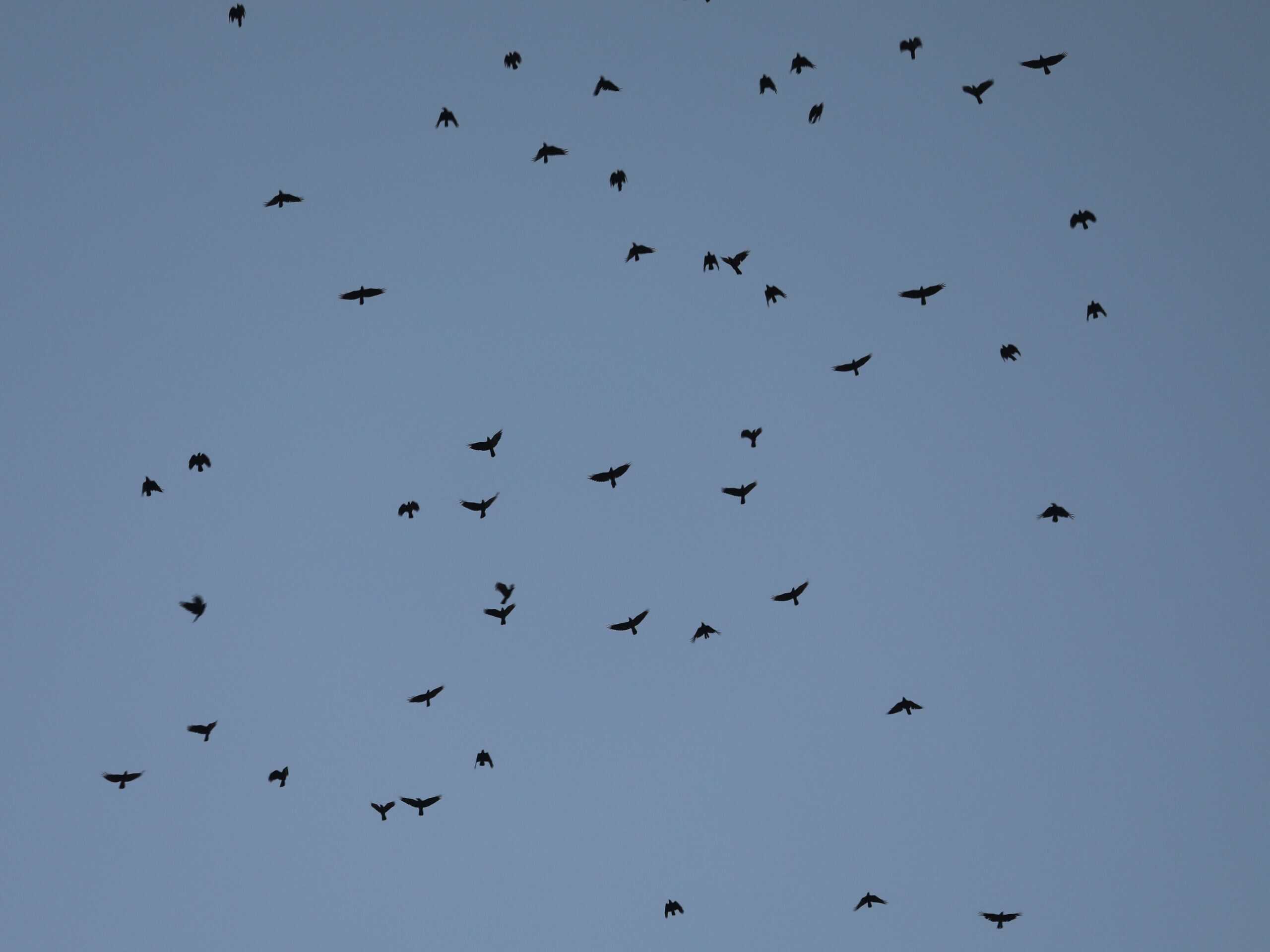
American Crows in Maryland (September 2026).

American Crows in Maryland (September 2026).
Flocks: Pros & Cons
Why do some birds group together in flocks while others spend more time alone? It often comes down to two main factors – what they eat, and what eats them.
American Crow key facts
| Scientific name | Corvus brachyrhynchos |
|---|---|
| Family | Corvidae (Crows, Jays, and Magpies) |
| Order | Passeriformes |
| eBird species page | American Crow on eBird (code amecro) |
The main benefit that most birds gain from living in flocks is a reduced risk of being captured by a predator. They’re protected in four ways:
- Dilution – Each bird in a flock has a lower chance of being captured by a predator just because there are so many other options for a predator to choose.
- Confusion – Predators usually try to single out an individual to capture. The complicated movements of the flock make it hard to stay on target.
- Vigilance – Birds in flocks can spend more time searching for food and less time scanning for predators. As long as a few birds are watching, they can alert the entire flock when danger is detected.
- Defense – Some flocks gang up on predators to chase them off.
Birds in flocks also have an easier time finding food, when food is abundant but clumped in limited locations. For example, blackbirds find grain and other seeds in agricultural fields during the winter, or sandpipers may find a beach teeming with small insects to eat. Birds get this benefit in locations where there is so much food that the whole flock can eat.
Flocking doesn’t come without some disadvantages. If there’s not quite enough food to feed a flock, the flock members will start competing with each other, and some will break off alone or in smaller flocks to look for food elsewhere. If food is very scarce or too spread out, then flocks may never form in the first place. Flocks also increase the spread of diseases and parasites among birds.


About The Author
Dan Hinnebusch is the Ornithologist for Wild Birds Unlimited. Click to learn more.
