

American Black Duck
Look closely at a flock of Mallards this time of year, and you might find a similar species, the American Black Duck. Black Ducks are closely related to Mallards (they frequently hybridize), and they look a lot like female Mallards. As their name suggests, Black Ducks are much darker in color overall, with a paler face and a yellowish-green bill. Also watch for the speculum, a patch of colorful flight feathers on the wing of many ducks. A Mallard’s speculum (male or female) is blue with white edges. The speculum of an American Black Duck is purple with no white edges. Another difference is found on the bottom of the wing, where American Black Ducks have a bold white patch of feathers, seen only when they fly or stretch their wings.
Unlike the common Mallard, American Black Ducks are scarce in Pennsylvania during the breeding season. Most fly farther north, with some breeding along the shores of the Hudson Bay in Canada. They also nest in beaver ponds throughout the forests of southeastern Canada, in the Great Lakes region, along the St Lawrence River in Canada, and along the Atlantic Coast from the Outer Banks of North Carolina to Newfoundland and Labrador in Canada.
American Black Ducks are a conservation concern. For example, the Chesapeake Bay used to host around 200 thousand Black Ducks each winter. That population dropped to less than 40 thousand by 2005 due to over hunting, habitat destruction, and increased rates of hybridization with Mallards. Canada and the United States passed stricter hunting regulations in the 1980s, which helped slow population declines. The Chesapeake Bay Foundation has been working for years to restore habitat in the Bay, with a goal of increasing the winter population to over 100 thousand birds.

American Black Ducks in Lancaster County (December 2015)
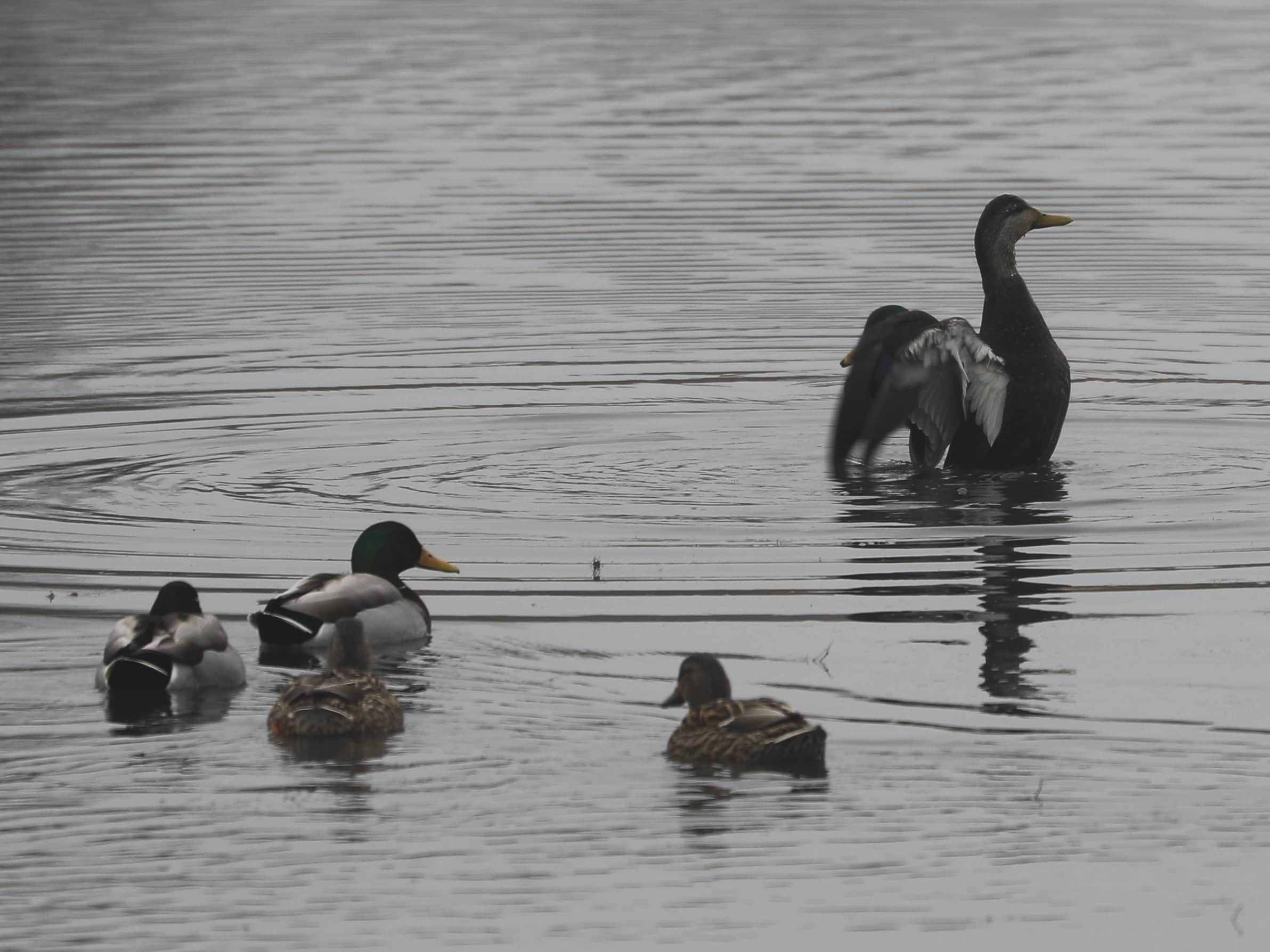
American Black Duck (right) with Mallards in Lancaster County (February 2026)

American Black Ducks in Lancaster County (December 2015)
American Black Duck
Look closely at a flock of Mallards this time of year, and you might find a similar species, the American Black Duck. Black Ducks are closely related to Mallards (they frequently hybridize), and they look a lot like female Mallards. As their name suggests, Black Ducks are much darker in color overall, with a paler face and a yellowish-green bill. Also watch for the speculum, a patch of colorful flight feathers on the wing of many ducks. A Mallard’s speculum (male or female) is blue with white edges. The speculum of an American Black Duck is purple with no white edges. Another difference is found on the bottom of the wing, where American Black Ducks have a bold white patch of feathers, seen only when they fly or stretch their wings.
Unlike the common Mallard, American Black Ducks are scarce in Pennsylvania during the breeding season. Most fly farther north, with some breeding along the shores of the Hudson Bay in Canada. They also nest in beaver ponds throughout the forests of southeastern Canada, in the Great Lakes region, along the St Lawrence River in Canada, and along the Atlantic Coast from the Outer Banks of North Carolina to Newfoundland and Labrador in Canada.
American Black Ducks are a conservation concern. For example, the Chesapeake Bay used to host around 200 thousand Black Ducks each winter. That population dropped to less than 40 thousand by 2005 due to over hunting, habitat destruction, and increased rates of hybridization with Mallards. Canada and the United States passed stricter hunting regulations in the 1980s, which helped slow population declines. The Chesapeake Bay Foundation has been working for years to restore habitat in the Bay, with a goal of increasing the winter population to over 100 thousand birds.
American Black Duck (right) with Mallards in Lancaster County (February 2026)


About The Author
Dan Hinnebusch is the Ornithologist for Wild Birds Unlimited. Click to learn more.
