

Field Birds: Horned Larks
Freshly fallen snow can be a great birding opportunity. Birds like Horned Larks that live in fields are usually pretty hard to find, because they’re often far away and their camouflage helps them blend in with the brownish winter grass. After snow falls, larks and other field birds often concentrate near roads, where snow plows scrape away the snow and make it easier to find food. Even when they’re far from the road, field birds lose their camouflage when the ground is covered with snow. The best birding opportunity comes when fresh manure is spread on a snowy field. The insects that are attracted to the manure are a favorite food of field birds.
Field birds can be a lot of fun to watch. They often move around in large flocks, and there are almost always birds in motion. Looking through a flock of about a thousand Horned Larks, I was able to find some less common winter visitors like Snow Buntings and Lapland Longspurs, birds that nest far to the north in the Arctic Circle. Eventually, the flock scattered and flew out of sight when a Northern Harrier (a hawk adapted to open field habitats) appeared over the crest of a hill. Plenty of other neat birds can be seen in field habitats, including songbirds like American Pipits, owls like Snowy Owls and Short-eared Owls, and raptors like Rough-legged Hawks, American Kestrels, and Merlins.
Horned Larks are our most abundant field bird in the Susquehanna Valley. They’re named for some horn-shaped feathers, which are faintly visible in the close-up photo. No birds have true horns, only feathers that are somewhat horn-shaped. We have several North American birds named for their “horns,” including Great Horned Owl, Horned Grebe, and Horned Puffin. There’s also a whole family of birds (more than 60 species) in Africa and Asia called hornbills. Hornbills look a bit like toucans, with large, horn-shaped bills. The most famous hornbill is Zazu, Mufasa’s advisor in the Disney movie The Lion King.
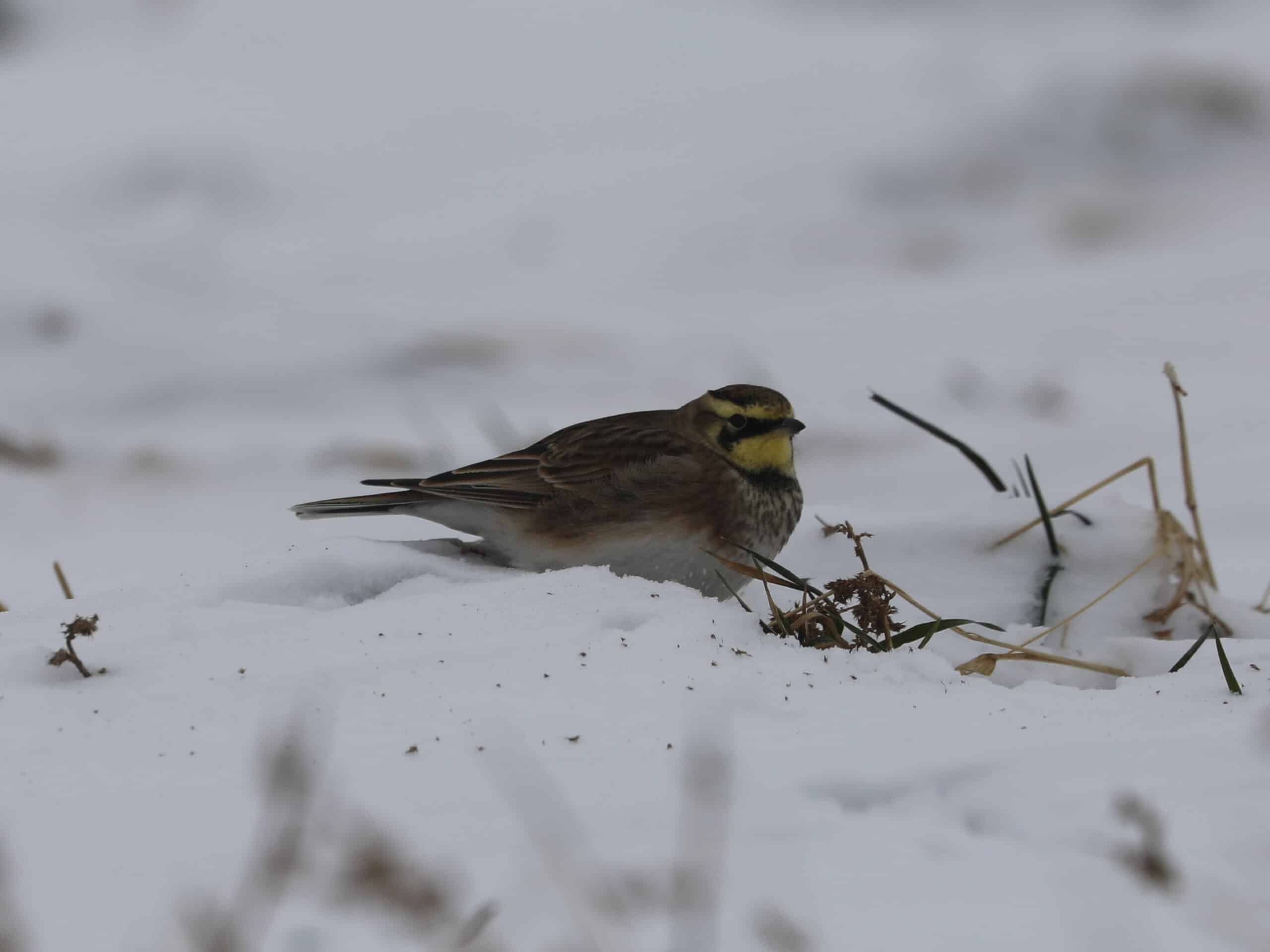
Horned Lark in Lebanon County (December 2025)
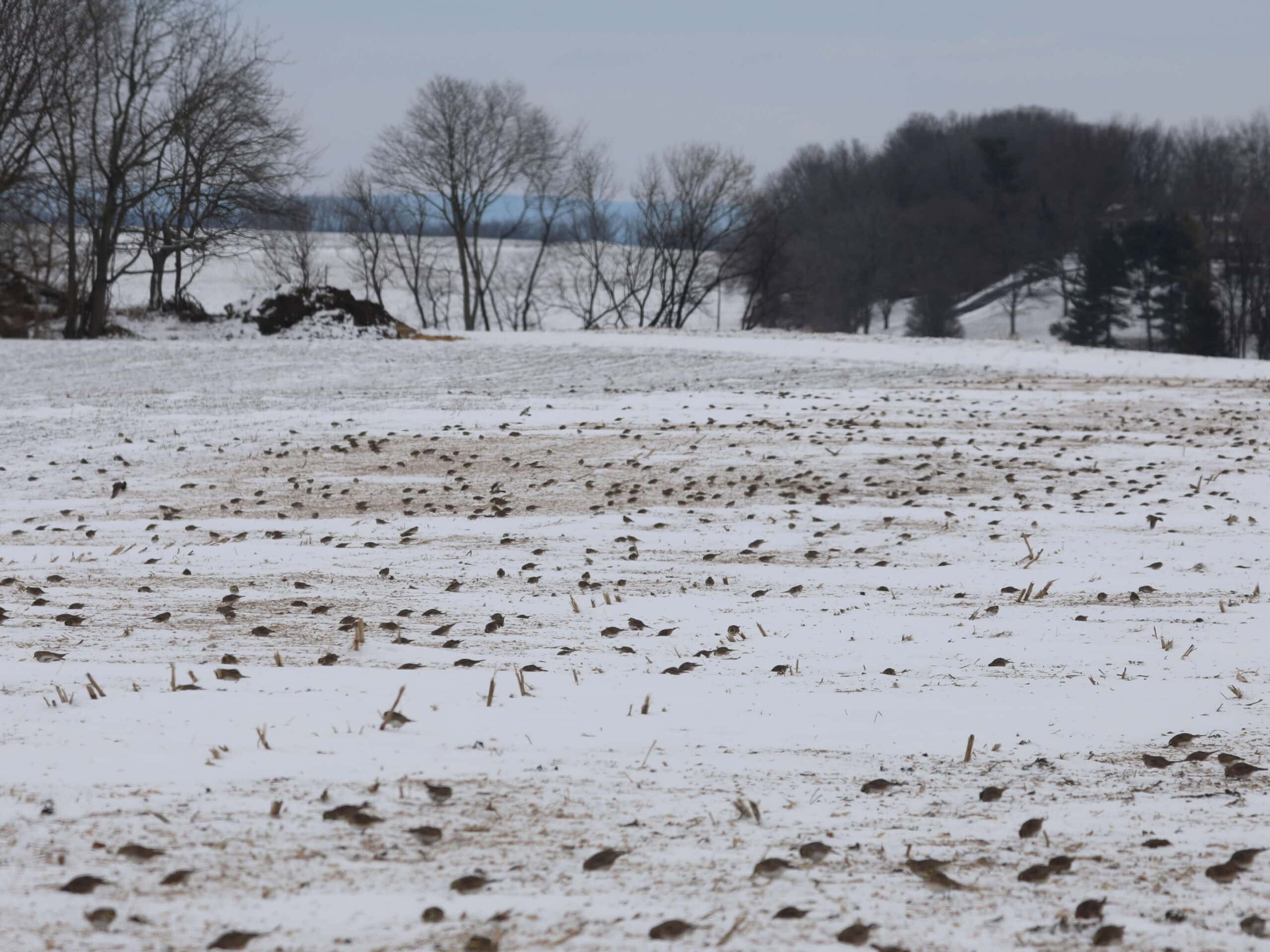
Hundreds of Horned Larks in Lebanon County (December 2025)

Horned Lark in Lebanon County (December 2025)
Field Birds: Horned Larks
Freshly fallen snow can be a great birding opportunity. Birds like Horned Larks that live in fields are usually pretty hard to find, because they’re often far away and their camouflage helps them blend in with the brownish winter grass. After snow falls, larks and other field birds often concentrate near roads, where snow plows scrape away the snow and make it easier to find food. Even when they’re far from the road, field birds lose their camouflage when the ground is covered with snow. The best birding opportunity comes when fresh manure is spread on a snowy field. The insects that are attracted to the manure are a favorite food of field birds.
Field birds can be a lot of fun to watch. They often move around in large flocks, and there are almost always birds in motion. Looking through a flock of about a thousand Horned Larks, I was able to find some less common winter visitors like Snow Buntings and Lapland Longspurs, birds that nest far to the north in the Arctic Circle. Eventually, the flock scattered and flew out of sight when a Northern Harrier (a hawk adapted to open field habitats) appeared over the crest of a hill. Plenty of other neat birds can be seen in field habitats, including songbirds like American Pipits, owls like Snowy Owls and Short-eared Owls, and raptors like Rough-legged Hawks, American Kestrels, and Merlins.
Horned Larks are our most abundant field bird in the Susquehanna Valley. They’re named for some horn-shaped feathers, which are faintly visible in the close-up photo. No birds have true horns, only feathers that are somewhat horn-shaped. We have several North American birds named for their “horns,” including Great Horned Owl, Horned Grebe, and Horned Puffin. There’s also a whole family of birds (more than 60 species) in Africa and Asia called hornbills. Hornbills look a bit like toucans, with large, horn-shaped bills. The most famous hornbill is Zazu, Mufasa’s advisor in the Disney movie The Lion King.
Hundreds of Horned Larks in Lebanon County (December 2025)


About The Author
Dan Hinnebusch is the Ornithologist for Wild Birds Unlimited. Click to learn more.
