

Northern Mockingbird
Spring is one of the best times of year to hear the song of the Northern Mockingbird. They sing during all seasons, but their songs are more complicated and exuberant in spring as the nesting season approaches. Mockingbirds are light gray in color, with darker tail and wing feathers. When they fly, watch for a patch of white on each wing and strips of white on the outer edges of the tail.
Mockingbirds were named for their beautiful repertoire of vocalizations. They repeatedly mimic the calls and songs of other birds with a rolling, musical cadence. Unlike most songbirds, mockingbirds continue learning new songs for their entire lives. A single mockingbird may know more than 200 songs! Mockingbirds’ singing abilities once made them popular as pets in the United States. Some mockingbirds were sold in the early 1800s for as much as $50, which is equivalent to about $1,700 in today’s money. It is no longer legal to keep mockingbirds (or any other native North American birds) as pets in the United States.
Mockingbirds occasionally visit feeders, especially for Bark Butter, Bark Butter Bits, mealworms, suet, fruit, jelly, and sunflower chips. While it’s usually fun to have a mockingbird visit your yard, they do sometimes cause frustration. They can be aggressive and will sometimes defend feeders and prevent other birds from approaching. If that happens in your yard, your best bet is to spread your feeders out. Offering feeders in several locations makes it very difficult for a mockingbird to defend each feeder.

Northern Mockingbird in Dan & Melissa’s yard (February 2026)
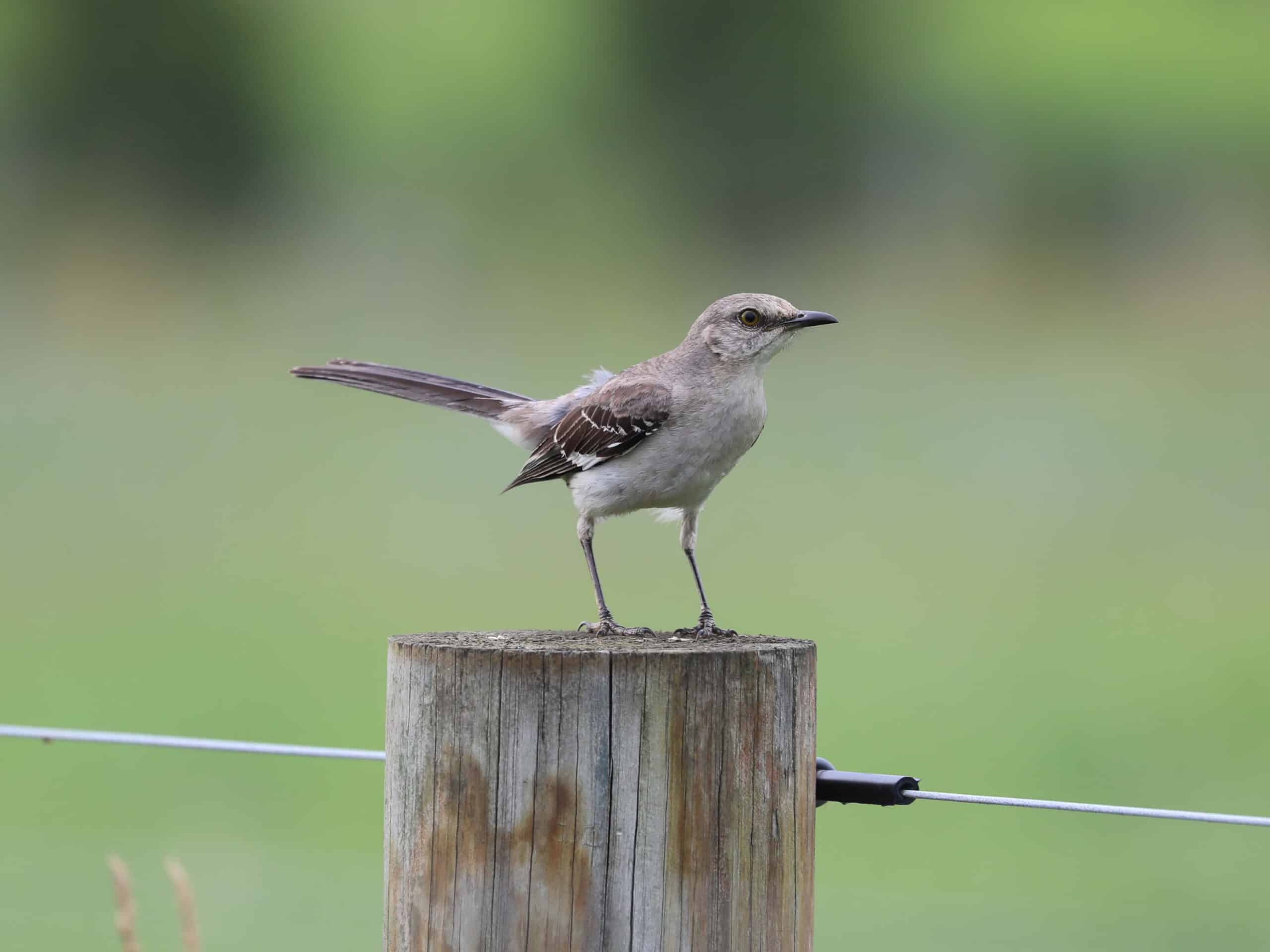
Northern Mockingbird in Montgomery County (July 2021)

Northern Mockingbird in Dan & Melissa’s yard (February 2026)
Northern Mockingbird
Spring is one of the best times of year to hear the song of the Northern Mockingbird. They sing during all seasons, but their songs are more complicated and exuberant in spring as the nesting season approaches. Mockingbirds are light gray in color, with darker tail and wing feathers. When they fly, watch for a patch of white on each wing and strips of white on the outer edges of the tail.
Mockingbirds were named for their beautiful repertoire of vocalizations. They repeatedly mimic the calls and songs of other birds with a rolling, musical cadence. Unlike most songbirds, mockingbirds continue learning new songs for their entire lives. A single mockingbird may know more than 200 songs! Mockingbirds’ singing abilities once made them popular as pets in the United States. Some mockingbirds were sold in the early 1800s for as much as $50, which is equivalent to about $1,700 in today’s money. It is no longer legal to keep mockingbirds (or any other native North American birds) as pets in the United States.
Mockingbirds occasionally visit feeders, especially for Bark Butter, Bark Butter Bits, mealworms, suet, fruit, jelly, and sunflower chips. While it’s usually fun to have a mockingbird visit your yard, they do sometimes cause frustration. They can be aggressive and will sometimes defend feeders and prevent other birds from approaching. If that happens in your yard, your best bet is to spread your feeders out. Offering feeders in several locations makes it very difficult for a mockingbird to defend each feeder.
Northern Mockingbird in Montgomery County (July 2021)


About The Author
Dan Hinnebusch is the Ornithologist for Wild Birds Unlimited. Click to learn more.
