

Rose-breasted Grosbeaks
Rose-breasted Grosbeaks are a common forest-nesting bird across most of Pennsylvania during late spring and summer. The Susquehanna Valley and other parts of southeastern Pennsylvania are some of the only parts of the state where few nest. In our area, we usually get to see them in the first couple weeks of May as they migrate north, then again during the month of September as they head back south. Increase your chances of seeing a grosbeak by offering sunflower or safflower seed in a tray or hopper feeder. Grosbeaks nest across the northeastern United States and southeastern and south-central Canada. During the winter, they live in Central America, northern South America, and on islands in the Caribbean Sea.
Last month I came across several singing Rose-breasted Grosbeaks in a part of the state where they nest. Grosbeaks have a beautiful song – it has a sing-song pattern like the song of an American Robin, but it’s more musical and has a sweeter whistle. One of the nicknames for Rose-breasted Grosbeaks is “the robin with voice lessons.” Males and females look very different, but both sing. Nesting is a true team effort. Both sexes build the nest, incubate the eggs, brood the nestlings, and bring back food for their young.
Rose-breasted Grosbeaks are one of seven species in Pennsylvania in the cardinal family. The Northern Cardinal itself is a bit of an oddball within that group because it’s the only non-migratory species. With an estimated Pennsylvania breeding population of 400 thousand, Rose-breasted Grosbeaks are less abundant than three of the other “cardinals,” the Indigo Bunting (3.0 million), Northern Cardinal (2.8 million), and Scarlet Tanager (1.2 million). Less common members of the family include Blue Grosbeaks (less than four thousand), and two rare species, Summer Tanager, and Dickcissel.

Rose-breasted Grosbeak (male) in Beaver County (June 2025)
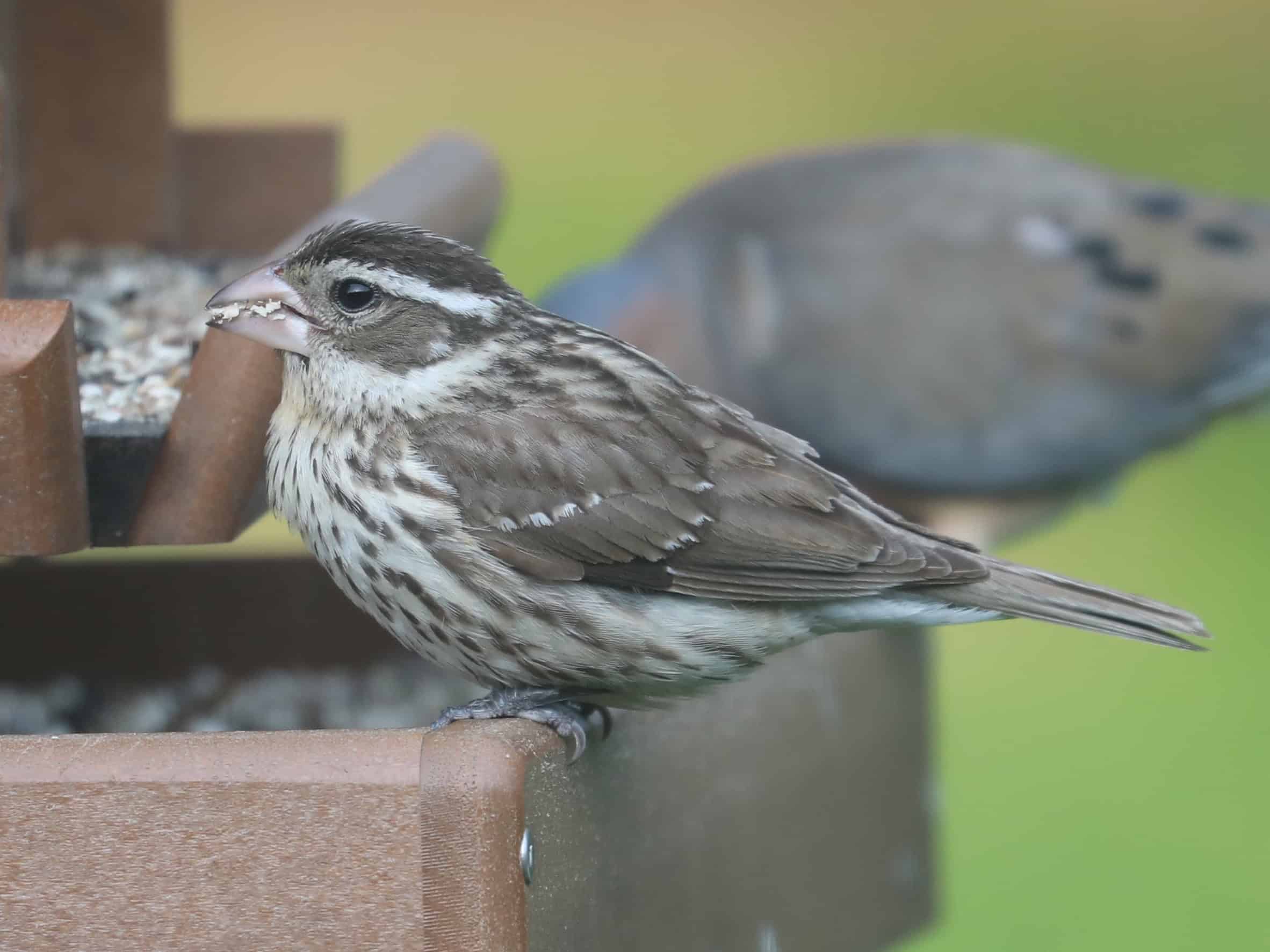
Rose-breasted Grosbeak (female) in Dan & Melissa’s yard (May 2021)

Rose-breasted Grosbeak (male) in Beaver County (June 2025)
Rose-breasted Grosbeaks
Rose-breasted Grosbeaks are a common forest-nesting bird across most of Pennsylvania during late spring and summer. The Susquehanna Valley and other parts of southeastern Pennsylvania are some of the only parts of the state where few nest. In our area, we usually get to see them in the first couple weeks of May as they migrate north, then again during the month of September as they head back south. Increase your chances of seeing a grosbeak by offering sunflower or safflower seed in a tray or hopper feeder. Grosbeaks nest across the northeastern United States and southeastern and south-central Canada. During the winter, they live in Central America, northern South America, and on islands in the Caribbean Sea.
Last month I came across several singing Rose-breasted Grosbeaks in a part of the state where they nest. Grosbeaks have a beautiful song – it has a sing-song pattern like the song of an American Robin, but it’s more musical and has a sweeter whistle. One of the nicknames for Rose-breasted Grosbeaks is “the robin with voice lessons.” Males and females look very different, but both sing. Nesting is a true team effort. Both sexes build the nest, incubate the eggs, brood the nestlings, and bring back food for their young.
Rose-breasted Grosbeaks are one of seven species in Pennsylvania in the cardinal family. The Northern Cardinal itself is a bit of an oddball within that group because it’s the only non-migratory species. With an estimated Pennsylvania breeding population of 400 thousand, Rose-breasted Grosbeaks are less abundant than three of the other “cardinals,” the Indigo Bunting (3.0 million), Northern Cardinal (2.8 million), and Scarlet Tanager (1.2 million). Less common members of the family include Blue Grosbeaks (less than four thousand), and two rare species, Summer Tanager, and Dickcissel.
Rose-breasted Grosbeak (female) in Dan & Melissa’s yard (May 2021)


About The Author
Dan Hinnebusch is the Ornithologist for Wild Birds Unlimited. Click to learn more.
