

Alarm Calls: Cooper’s Hawk
Have you ever been listening to birds singing and calling, then heard multiple birds abruptly change their calls? I experienced that last week while loading merchandise into my car behind the Lancaster store. There is a patch of brush and trees behind the store where I saw several Northern Cardinals, Gray Catbirds, and House Sparrows. They were moving around in the bushes and calling frequently.
Cooper's Hawk key facts
| Scientific name | Astur cooperii |
|---|---|
| Family | Accipitridae (Hawks, Eagles, and Kites) |
| Order | Accipitriformes |
| eBird species page | Cooper's Hawk on eBird (code coohaw) |
Fun fact: Cooper didn't name the species himself. It was named in his honor by fellow naturalist Charles Lucien Bonaparte, a nephew of Emperor Napoleon Bonaparte.
Suddenly, all movement stopped and the birds got quiet. I looked up to see a young Cooper’s Hawk fly through the trees and land on the building. As soon as the hawk landed, most of the songbirds began low pitched, chattering calls, and every songbird I could see had stopped looking for food and was carefully watching the hawk.
What I saw and heard is part of the songbirds’ strategy to protect themselves against hawks. They react differently to a flying predator than to one that has perched. A flying hawk is an immediate threat, attempting to use the element of surprise to capture their prey. Birds often use high-pitched alarm calls when they see a flying hawk. The high pitch makes it difficult for the hawk to pinpoint the location of the calling bird. When other birds hear those high-pitched alarm calls, they dive for cover and then stop moving, trying to avoid notice.
After the hawk lands, it has lost the element of surprise, and the songbirds’ alarm calls change. Perched predators elicit lower pitched calls, often with a rough, chattering quality. When birds hear that type of alarm call, they often leave their hiding places to get a good look at where the predator is sitting. Many birds, especially social species like chickadees, titmice, and mockingbirds, may actually start diving at the hawk and attacking it – a behavior called mobbing. If the mobbing is successful, the hawk will fly away and try hunting in a different area.
From the perspective of the hawk, songbird alarm calls can make it very difficult to find a meal. Everywhere they go, they’re observed by a network of vigilant birds ready to announce the presence of a predator. The information spread by these songbirds travels much faster than the hawk itself. With so much working against hawks, it seems remarkable that they ever catch a songbird.
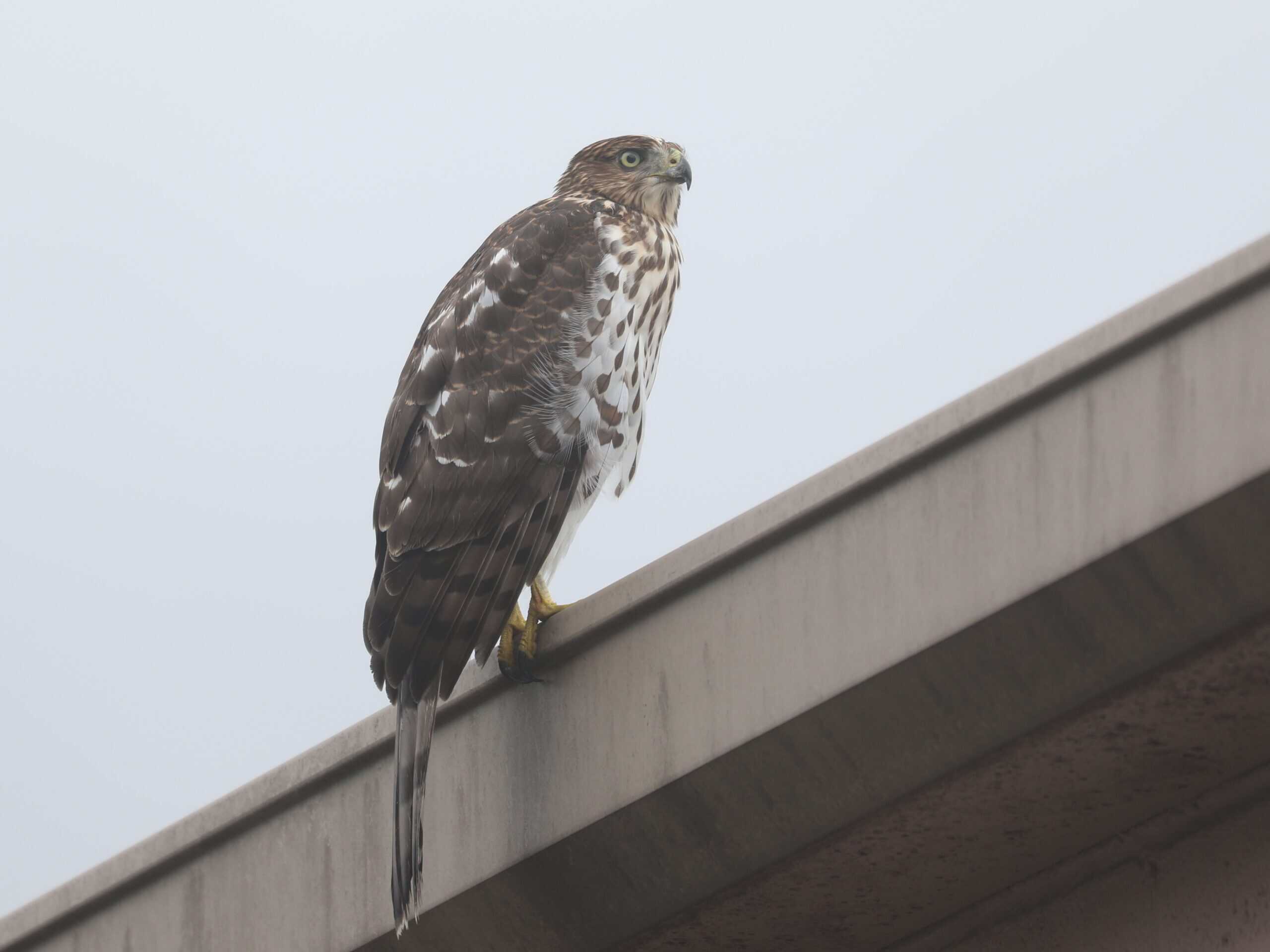
Cooper’s Hawk outside the Wild Birds Unlimited Nature Shop in Lancaster (August 2026).

Cooper’s Hawk outside the Wild Birds Unlimited Nature Shop in Lancaster (August 2026).
Alarm Calls: Cooper’s Hawk
Have you ever been listening to birds singing and calling, then heard multiple birds abruptly change their calls? I experienced that last week while loading merchandise into my car behind the Lancaster store. There is a patch of brush and trees behind the store where I saw several Northern Cardinals, Gray Catbirds, and House Sparrows. They were moving around in the bushes and calling frequently.
Cooper's Hawk key facts
| Scientific name | Astur cooperii |
|---|---|
| Family | Accipitridae (Hawks, Eagles, and Kites) |
| Order | Accipitriformes |
| eBird species page | Cooper's Hawk on eBird (code coohaw) |
Fun fact: Cooper didn't name the species himself. It was named in his honor by fellow naturalist Charles Lucien Bonaparte, a nephew of Emperor Napoleon Bonaparte.
Suddenly, all movement stopped and the birds got quiet. I looked up to see a young Cooper’s Hawk fly through the trees and land on the building. As soon as the hawk landed, most of the songbirds began low pitched, chattering calls, and every songbird I could see had stopped looking for food and was carefully watching the hawk.
What I saw and heard is part of the songbirds’ strategy to protect themselves against hawks. They react differently to a flying predator than to one that has perched. A flying hawk is an immediate threat, attempting to use the element of surprise to capture their prey. Birds often use high-pitched alarm calls when they see a flying hawk. The high pitch makes it difficult for the hawk to pinpoint the location of the calling bird. When other birds hear those high-pitched alarm calls, they dive for cover and then stop moving, trying to avoid notice.
After the hawk lands, it has lost the element of surprise, and the songbirds’ alarm calls change. Perched predators elicit lower pitched calls, often with a rough, chattering quality. When birds hear that type of alarm call, they often leave their hiding places to get a good look at where the predator is sitting. Many birds, especially social species like chickadees, titmice, and mockingbirds, may actually start diving at the hawk and attacking it – a behavior called mobbing. If the mobbing is successful, the hawk will fly away and try hunting in a different area.
From the perspective of the hawk, songbird alarm calls can make it very difficult to find a meal. Everywhere they go, they’re observed by a network of vigilant birds ready to announce the presence of a predator. The information spread by these songbirds travels much faster than the hawk itself. With so much working against hawks, it seems remarkable that they ever catch a songbird.


About The Author
Dan Hinnebusch is the Ornithologist for Wild Birds Unlimited. Learn more about Dan Hinnebusch.
