

Blue-gray Gnatcatcher
One of our smallest birds has returned on spring migration. Weighing less than a third of an ounce, the Blue-gray Gnatcatcher is smaller than all other Pennsylvania birds, except for the Ruby-throated Hummingbird and the Golden-crowned Kinglet. This active little insect eater spends its time searching for food on the leaves of deciduous trees. Despite its name, it actually doesn’t eat many gnats. Its favorite foods include spiders and a variety of insects like leafhoppers, beetles, and caterpillars.
As gnatcatchers look for prey, they constantly flash the white patches on their tails from side to side, which may help to startle insects and reveal their hiding places. The overall gray color of gnatcatchers, coupled with the white patches on the tail and their behavior, give the gnatcatcher the nickname “tiny mockingbird” – mockingbirds weigh 6 to 8 times more than gnatcatchers. Gnatcatchers will even mimic the calls of other birds, a behavior for which mockingbirds are famous. Despite those similarities, mockingbirds and gnatcatchers are not closely related.
There are 18 species of gnatcatchers in the world, all in the Western Hemisphere. The Blue-gray Gnatcatcher is the most widespread in North America, and it’s also the only migratory gnatcatcher. You can find them nesting across most of the United States and Mexico, plus southern parts of Ontario and Quebec. They migrate south in the winter, and are found in the southern United States, Mexico, Cuba, and parts of Central America.

Blue-gray Gnatcatcher in Lancaster County (April 2026)
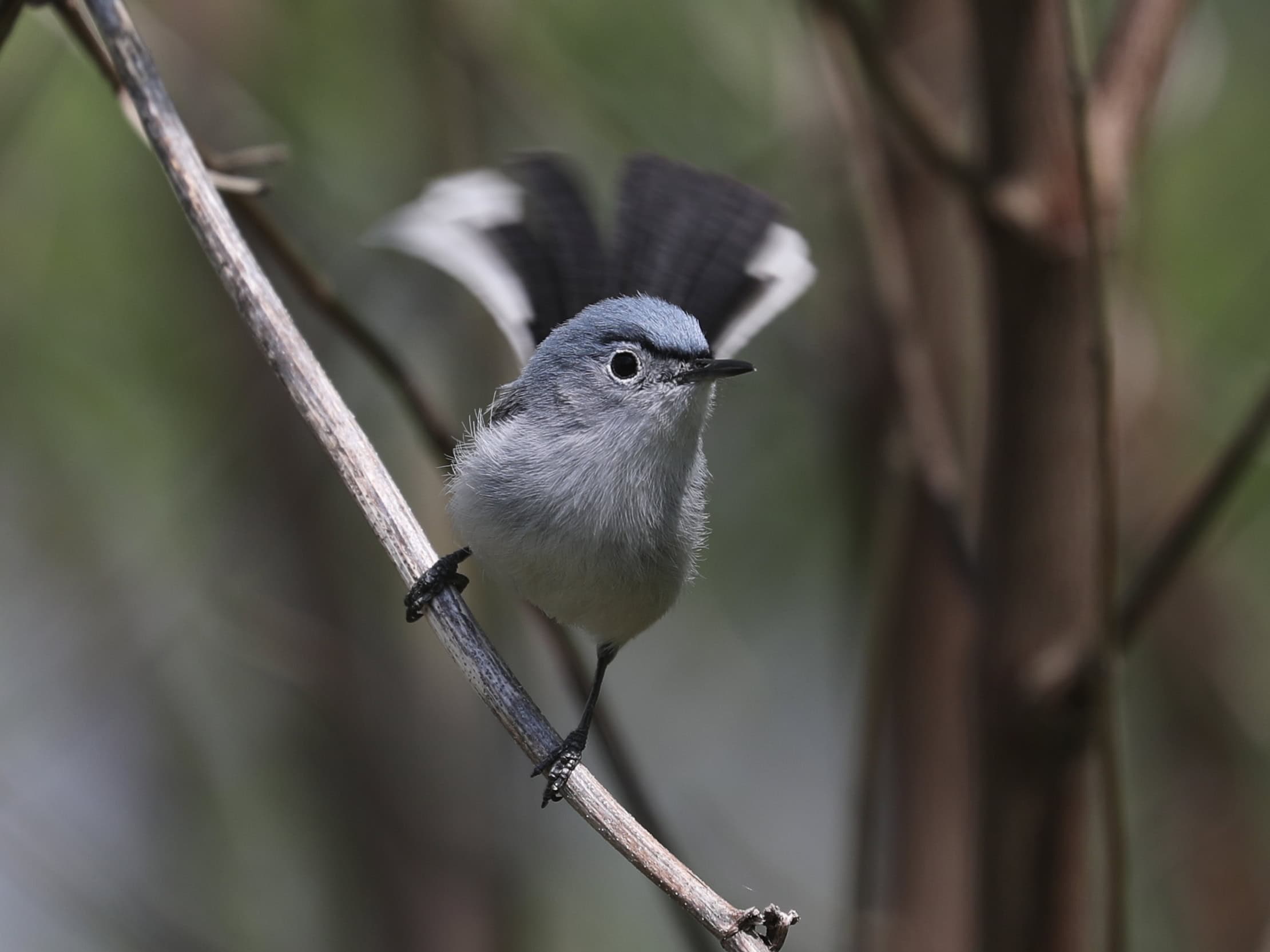
Blue-gray Gnatcatcher flashing its distinctive tail in Lancaster County (April 2026)

Blue-gray Gnatcatcher in Lancaster County (April 2026)
Blue-gray Gnatcatcher
One of our smallest birds has returned on spring migration. Weighing less than a third of an ounce, the Blue-gray Gnatcatcher is smaller than all other Pennsylvania birds, except for the Ruby-throated Hummingbird and the Golden-crowned Kinglet. This active little insect eater spends its time searching for food on the leaves of deciduous trees. Despite its name, it actually doesn’t eat many gnats. Its favorite foods include spiders and a variety of insects like leafhoppers, beetles, and caterpillars.
As gnatcatchers look for prey, they constantly flash the white patches on their tails from side to side, which may help to startle insects and reveal their hiding places. The overall gray color of gnatcatchers, coupled with the white patches on the tail and their behavior, give the gnatcatcher the nickname “tiny mockingbird” – mockingbirds weigh 6 to 8 times more than gnatcatchers. Gnatcatchers will even mimic the calls of other birds, a behavior for which mockingbirds are famous. Despite those similarities, mockingbirds and gnatcatchers are not closely related.
There are 18 species of gnatcatchers in the world, all in the Western Hemisphere. The Blue-gray Gnatcatcher is the most widespread in North America, and it’s also the only migratory gnatcatcher. You can find them nesting across most of the United States and Mexico, plus southern parts of Ontario and Quebec. They migrate south in the winter, and are found in the southern United States, Mexico, Cuba, and parts of Central America.
Blue-gray Gnatcatcher flashing its distinctive tail in Lancaster County (April 2026)


About The Author
Dan Hinnebusch is the Ornithologist for Wild Birds Unlimited. Click to learn more.
