

Keep Track of Birds Visiting Your Yard with a Yard List
Many birders keep several lists of birds. The most important is a life list, the list of all species of birds they’ve seen. The life list can be broken down into more specific lists, documenting birds seen in a particular country, state, or county, or in a certain month or year. One of my favorite lists to keep is my yard list, which includes birds that visit my yard, plus birds that I see from my yard.
If you started listing the species you see in your yard, you’d probably be surprised at the diversity of your local bird community. I started keeping track of my yard list in the fall of 2012, and I added 38 species by the end of the year. After a year of counting the list was at 65. I added my 100th species in March of 2016 when a pair of Wood Ducks flew over the yard. The more species you add, the harder it gets to find new species. After adding #145, an Acadian Flycatcher, in September 2023, I had to wait more than two years to add any new species. I got lucky in late 2025 and saw #146, a Golden Eagle circling overhead on Halloween, and #147, a Greater White-fronted Goose flying by with some Canada Geese a few days before Christmas.
If you’d like to keep a list, consider using the free eBird app. I’ve learned a lot about the birds in my yard using that tool. For example, I know to watch for Rose-breasted Grosbeaks during the first week of May as they arrive in our area on spring migration. I can see that Ruby-throated Hummingbirds visit between mid-April and early October, but August and September are by far the best time to see them. Dark-eyed Juncos are on the opposite end of the calendar, arriving in the fall in the first week of October, and departing before the end of April. Here is a list of the top ten most common birds in my yard during the month of January:
- White-throated Sparrow
- Northern Cardinal
- American Crow
- Dark-eyed Junco
- Carolina Chickadee
- House Sparrow
- American Robin
- House Finch
- Carolina Wren
- Canada Goose

Greater White-fronted Goose flying over Dan & Melissa’s yard (December 2025)
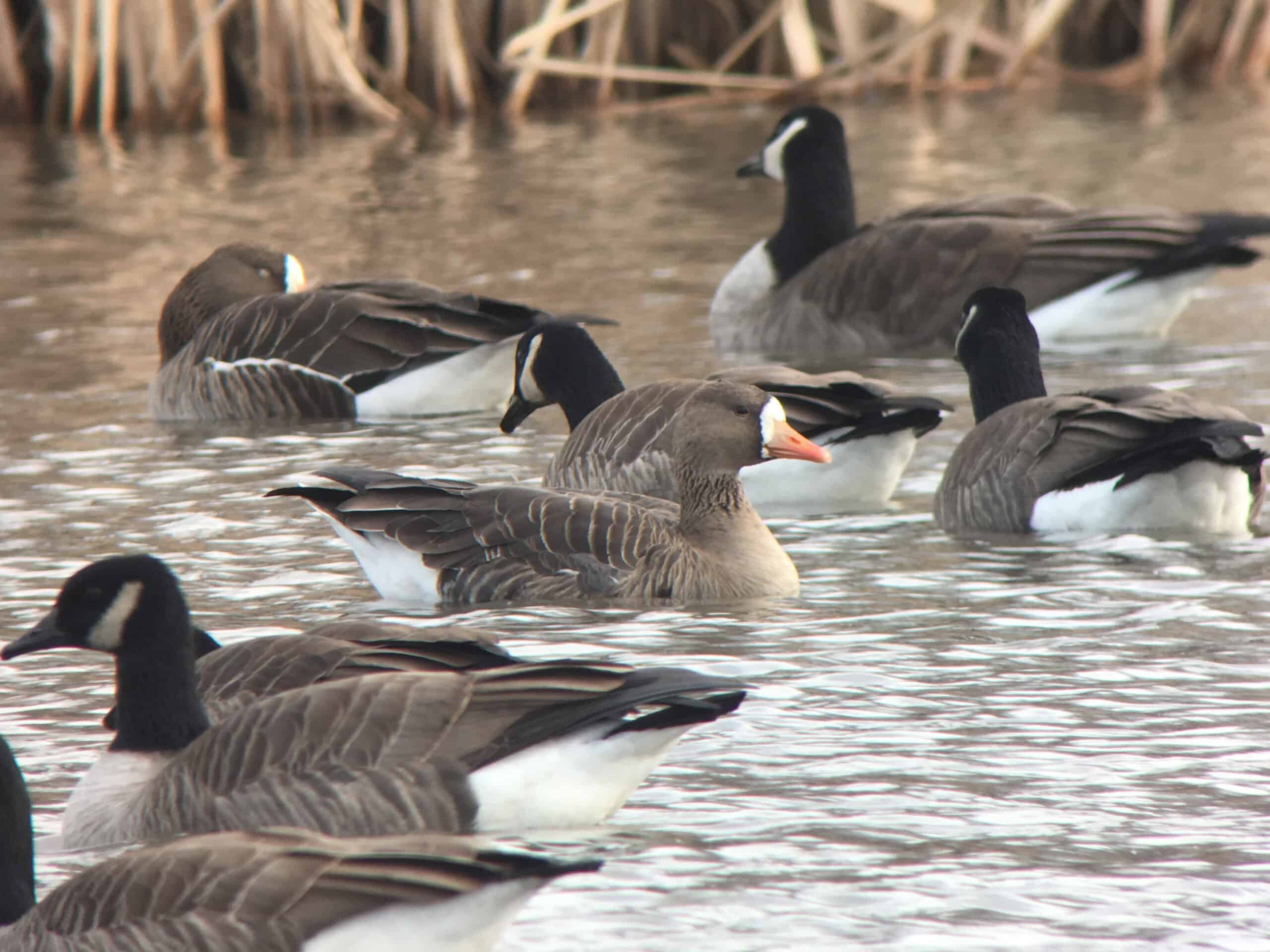
Greater White-fronted Geese with Canada Geese in Lancaster County (December 2017)

Greater White-fronted Goose flying over Dan & Melissa’s yard (December 2025)
Keep Track of Birds Visiting Your Yard with a Yard List
Many birders keep several lists of birds. The most important is a life list, the list of all species of birds they’ve seen. The life list can be broken down into more specific lists, documenting birds seen in a particular country, state, or county, or in a certain month or year. One of my favorite lists to keep is my yard list, which includes birds that visit my yard, plus birds that I see from my yard.
If you started listing the species you see in your yard, you’d probably be surprised at the diversity of your local bird community. I started keeping track of my yard list in the fall of 2012, and I added 38 species by the end of the year. After a year of counting the list was at 65. I added my 100th species in March of 2016 when a pair of Wood Ducks flew over the yard. The more species you add, the harder it gets to find new species. After adding #145, an Acadian Flycatcher, in September 2023, I had to wait more than two years to add any new species. I got lucky in late 2025 and saw #146, a Golden Eagle circling overhead on Halloween, and #147, a Greater White-fronted Goose flying by with some Canada Geese a few days before Christmas.
If you’d like to keep a list, consider using the free eBird app. I’ve learned a lot about the birds in my yard using that tool. For example, I know to watch for Rose-breasted Grosbeaks during the first week of May as they arrive in our area on spring migration. I can see that Ruby-throated Hummingbirds visit between mid-April and early October, but August and September are by far the best time to see them. Dark-eyed Juncos are on the opposite end of the calendar, arriving in the fall in the first week of October, and departing before the end of April. Here is a list of the top ten most common birds in my yard during the month of January:
- White-throated Sparrow
- Northern Cardinal
- American Crow
- Dark-eyed Junco
- Carolina Chickadee
- House Sparrow
- American Robin
- House Finch
- Carolina Wren
- Canada Goose
Greater White-fronted Geese with Canada Geese in Lancaster County (December 2017)


About The Author
Dan Hinnebusch is the Ornithologist for Wild Birds Unlimited. Click to learn more.
